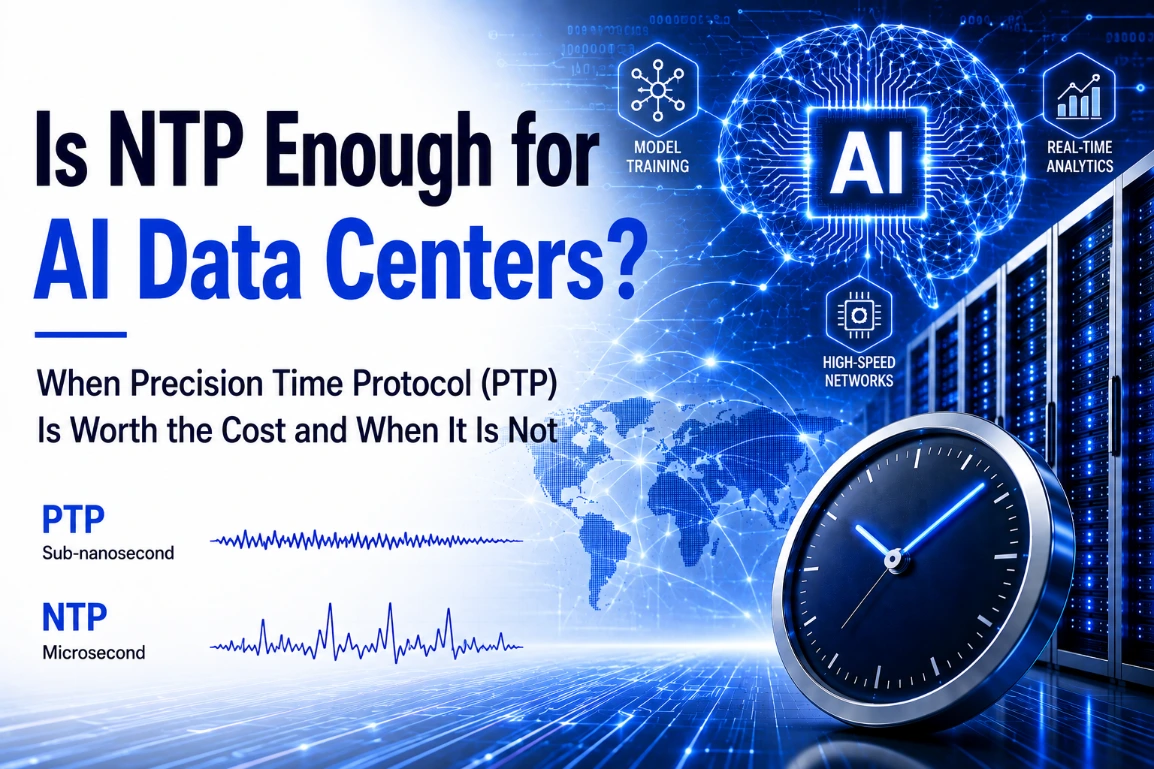
An AI cluster is a distributed system that happens to contain GPUs. Every node in it keeps its own clock, and every timestamp you troubleshoot with is only as trustworthy as the agreement between them. The real question is not whether your clocks agree. It is how closely they need to.
AI Changed What Time Is For
Artificial intelligence is transforming data centers. Modern AI environments are no longer a collection of independent servers. They are highly distributed systems made up of GPU clusters, high-speed Ethernet fabrics, distributed storage, orchestration platforms, and observability tools working together to train and serve increasingly sophisticated models.
As these environments grow, one infrastructure service receives almost no attention until something goes wrong: time synchronization.
Every system records events using its own local clock. When those clocks drift apart, reconstructing the sequence of events during an outage turns into guesswork. Engineers see logs that appear out of order, telemetry that conflicts between systems, and packet captures that cannot be reliably aligned.
One event, four timestamps
Each system records the same incident against its own clock. Offsets are measured from the packet capture.
| System and record | Clock offset | Position relative to capture |
|---|---|---|
| Packet captureNetwork TAP | Reference | |
| Leaf switchTelemetry | +3.1 ms | |
| GPU node 14Job log | −1.4 ms | |
| Storage arrayI/O trace | +0.6 ms |
So the question many organizations ask is whether Network Time Protocol (NTP) is still sufficient, or whether they should invest in Precision Time Protocol (PTP).
The answer depends on operational requirements, not on the assumption that AI automatically requires microsecond-level synchronization.
What NTP Already Does Well
NTP remains the standard method of synchronizing clocks across enterprise IT environments. It is mature, widely supported, and entirely sufficient for the majority of workloads running in a data center today.
What a well-tuned chrony deployment can typically hold across hosts on a controlled network. That is more than adequate when the events you are investigating unfold over milliseconds or seconds.
Where NTP Starts to Run Out of Room
As AI infrastructure scales, operations teams increasingly need to correlate events that occur across many systems inside very short windows. Five tasks come up again and again, and each one lives at a different timescale.
Investigating communication delays between GPU servers
Measuring one-way latency across the network
Reconstructing distributed failures after the fact
Aligning telemetry from switches, storage, and compute
Running security investigations across multiple systems
When timing uncertainty becomes comparable to the duration of the events being investigated, engineers spend more time establishing what happened than solving the underlying issue.
One Axis, Two Protocols
The tradeoff becomes much easier to reason about when both protocols and the events you actually investigate are placed on the same logarithmic axis.
Read the overlap: NTP already covers the time window of most application incidents. PTP becomes valuable when the event being measured is as short as NTP's own uncertainty.
Timing-equipment vendor research (Microchip) describes typical NTP performance in a LAN or spine environment as roughly 1 to 10 microseconds under normal conditions, with substantially larger worst-case error, while PTP is described as capable of sub-nanosecond synchronization in an engineered network. These figures come from a timing vendor rather than an independent industry benchmark, but they illustrate the scale of the tradeoff organizations are weighing.
PTP closes that gap by distributing time with far greater precision, particularly when it is paired with hardware timestamping and timing-aware network infrastructure.
Does PTP Make AI Faster?
- GPU performance
- Network bandwidth
- Storage throughput
- Model training time
- Confidence in event ordering across nodes
- Validity of one-way latency measurements
- Alignment of telemetry from different sources
- Ambiguity removed from an incident timeline
The value of PTP is observability, not throughput. Better synchronized clocks make it easier to correlate events across distributed systems and reduce ambiguity during troubleshooting. Whether that translates into faster incident resolution depends on the environment, and it should be validated through operational experience rather than assumed.
When PTP Earns Its Cost, and When It Does Not
Organizations that should put PTP on the table
- Operate large distributed AI clusters
- Need accurate one-way latency measurements
- Frequently troubleshoot distributed infrastructure issues
- Rely on detailed observability and telemetry
- Require precise event ordering across systems
Situations where PTP is likely unnecessary
- The cluster is small
- Relevant incidents unfold at millisecond scale or slower
- Existing chrony performance is stable and well understood
- Most troubleshooting is application-level rather than packet-level
If chrony already holds hosts within 10 to 50 microseconds and the events under investigation last milliseconds, tighter synchronization will not change the outcome. The gap has to actually matter before the hardware does.
For many enterprises the answer is not one protocol at all. Retaining NTP for general IT while deploying PTP only where it is operationally justified offers the best balance between capability and complexity.
Build the Business Case Before the Architecture
Rather than beginning with technology, begin with questions.
What operational problem are we actually trying to solve?
How much engineering time is spent on timing-related troubleshooting today?
Which workloads genuinely require tighter synchronization?
Will improved timing deliver a measurable operational benefit?
What would it cost, in hardware, deployment, and ongoing operations, to close that gap?
Only once these questions have answers does evaluating PTP hardware make sense.
Where E.C.I. NETWORKS Fits In
E.C.I. Networks helps organizations assess their current timing environment, identify real operational requirements, and determine whether enhanced synchronization is justified. The process begins with understanding your infrastructure, not with recommending hardware.
Optimize what you have
Tune and harden the existing NTP or chrony deployment until it is measured, understood, and trusted.
Deploy PTP selectively
Introduce PTP only on the AI workloads and fabric segments where the precision changes an operational outcome.
Design for resilience
Build an enterprise timing architecture with GNSS backing, holdover, and protection against reference loss.
NTP and PTP questions, answered
Does PTP make AI training run faster by itself?
No. PTP provides tighter clock alignment. It earns its cost when that alignment improves event correlation, measurement, distributed workflows or operational recovery.
When is NTP still the right choice?
NTP remains suitable when the application's accuracy and continuity requirements fit its measured performance and the network can operate it reliably.
What infrastructure does PTP require?
A complete design can include grandmasters, PTP-aware network devices, supported clients, redundant references, suitable profiles and monitoring.
Can NTP and PTP coexist?
Yes. Many environments use PTP for selected workloads and NTP for general systems, with both services tied to a well-managed reference architecture.
Build Timing You Can Rely On
Talk to E.C.I. NETWORKS about whether NTP, PTP, or a hybrid timing approach can help you build a more precise, resilient, and future-ready AI infrastructure.
Contact Our Team