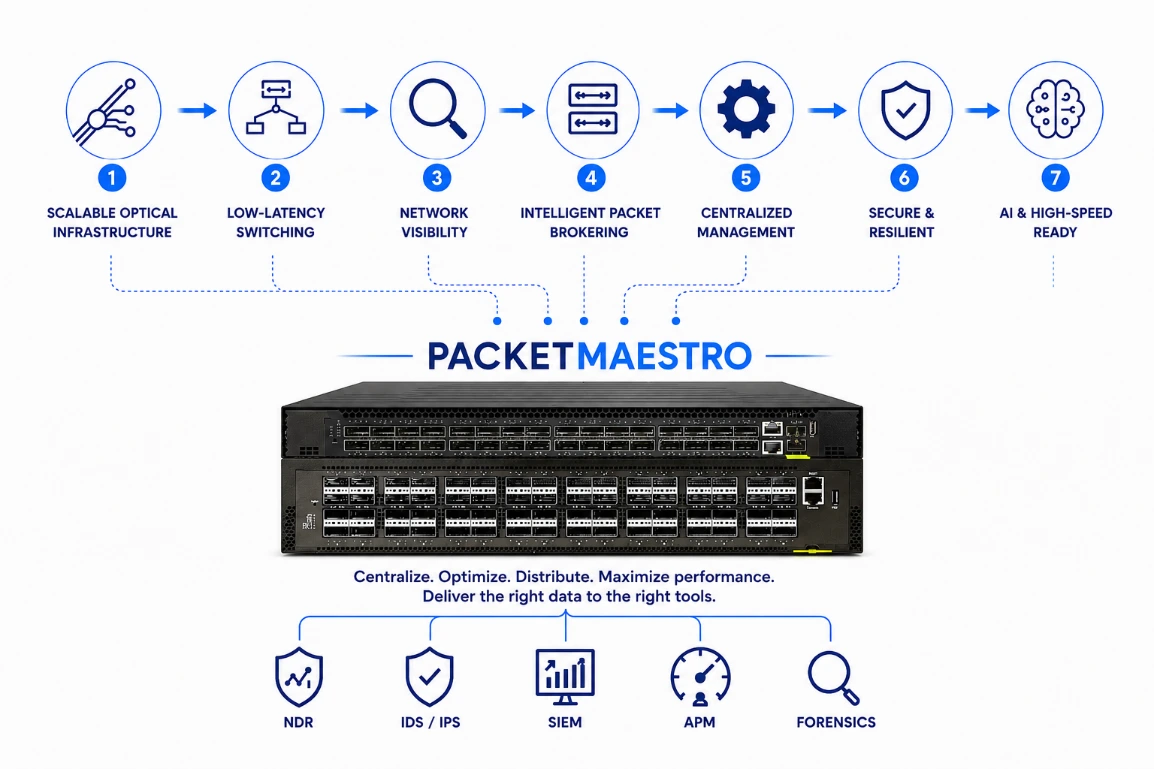
Why Connectivity Is the Foundation of Modern Data Centers
Today's data centers are evolving at an unprecedented pace. Artificial Intelligence (AI), cloud-native applications, virtualization, and East-West traffic have dramatically increased bandwidth demands while reducing acceptable latency. As organizations migrate toward 100G, 200G, 400G, and even 800G Ethernet, simply deploying faster switches is no longer enough.
The real challenge is ensuring that every packet reaches its destination efficiently while maintaining complete network visibility, security, and operational resilience. This is where modern connectivity solutions become the foundation of a high-performance data center.
Start with a Scalable Optical Infrastructure
The physical layer determines how well a network can scale in the future.
Modern data centers should adopt structured optical cabling capable of supporting multiple generations of Ethernet without requiring extensive recabling. High-density fiber solutions reduce rack space, simplify cable management, and improve airflow while supporting rapid deployment.
Key considerations include:
01MPO/MTP high-density fiber connectivity
02Low-loss optical components
03 Support for 100G, 200G, 400G
04Support for 800g links
05Modular patching architectures
06Simplified maintenance and expansion
A well-designed optical infrastructure provides the flexibility required to accommodate future technology upgrades while minimizing operational disruption.
Design for Low-Latency Switching
Once the physical layer is established, the switching infrastructure becomes the performance engine of the data center.
Modern leaf-spine architectures have become the industry standard because they provide:
Key considerations include:
- Predictable latency
- Non-blocking bandwidth
- Horizontal scalability
- Equal-cost multi-path (ECMP) routing
- Simplified network expansion
Open Networking switches running Enterprise SONiC provide a flexible platform capable of supporting advanced Layer 2 and Layer 3 services while reducing hardware costs compared to proprietary solutions.
Combined with modern Broadcom switching silicon, these platforms deliver wire-speed forwarding across hundreds of high-speed interfaces.
Build Visibility into the Network from Day One
One of the most common mistakes in data center design is treating network monitoring as an afterthought.
As traffic volumes increase, connecting every monitoring appliance directly to production switches quickly becomes impractical.
Instead, visibility should be built into the network architecture.
Optical TAPs provide a passive, fail-safe method of capturing traffic without introducing latency or becoming a point of failure. Unlike SPAN ports, TAPs deliver complete packet visibility without packet drops during periods of congestion.
This ensures monitoring tools always receive an accurate copy of production traffic.
Aggregate and Optimize Traffic with Intelligent Packet Brokers
Capturing traffic is only the first step.
Modern monitoring and security tools often receive far more data than they can efficiently process.
This is where intelligent packet brokers become essential.
Rather than sending every packet to every tool, a packet broker intelligently filters, aggregates, replicates, and distributes only the traffic required by each application.
Advanced packet brokers can provide capabilities such as:
- Traffic aggregation from multiple TAPs
- Load balancing across monitoring tools
- Header stripping
- VLAN filtering
- VXLAN decapsulation
- GRE and GTP tunnel processing
- ERSPAN termination
- Packet slicing
- Deduplication
- Timestamping
- Flow-based filtering
By reducing unnecessary traffic, organizations maximize the efficiency of expensive monitoring and security appliances while improving overall network performance.
Solutions such as PacketMaestro and PacketMaestro-PRO enable organizations to centralize packet visibility while supporting high-speed Ethernet environments ranging from 1G through 400G.
Aggregate and Optimize Traffic with Intelligent Packet Brokers
Centralize Network Operations. Managing dozens or hundreds of switches individually quickly becomes operationally inefficient.
Centralized network management platforms provide:
- Zero-touch provisioning
- Firmware lifecycle management
- Configuration automation
- Health monitoring
- Performance dashboards
- Alarm management
- Inventory management
- User authentication integration
- Role-based access control
Automation reduces configuration errors while dramatically accelerating deployments.
For organizations operating multiple sites, centralized orchestration becomes essential for maintaining consistent network policies.
By reducing unnecessary traffic, organizations maximize the efficiency of expensive monitoring and security appliances while improving overall network performance.
Solutions such as PacketMaestro and PacketMaestro-PRO enable organizations to centralize packet visibility while supporting high-speed Ethernet environments ranging from 1G through 400G.
Centralize Network Operations
Managing dozens or hundreds of switches individually quickly becomes operationally inefficient.Centralized network management platforms provide
Health monitoring
Inventory management
Firmware lifecycle management
Performance dashboards
User authentication integration
Configuration automation
Alarm management
Role-based access control
Automation reduces configuration errors while dramatically accelerating deployments.For organizations operating multiple sites, centralized orchestration becomes essential for maintaining consistent network policies.
Integrate Security Without Sacrificing Performance
High-performance networks must also be secure.
Visibility data collected through TAPs and packet brokers enables Network Detection and Response (NDR), Intrusion Detection Systems (IDS), Intrusion Prevention Systems (IPS), and forensic analysis platforms to operate without impacting production traffic.
Rather than competing for switch resources, security appliances receive optimized traffic feeds specifically tailored to their analytical requirements.
This architecture improves both security effectiveness and infrastructure efficiency.
Prepare for AI and High-Speed Ethernet
Artificial Intelligence workloads are rapidly transforming data center traffic patterns.
Large GPU clusters generate enormous East-West traffic volumes that require:
01Ultra-low latency
02Precision timing
03 Lossless Ethernet
04Intelligent traffic engineering
05High-bandwidth optical connectivity
06Continuous performance monitoring
Modern connectivity solutions provide the foundation needed to support these demanding environments while remaining flexible enough to accommodate future technologies.
Organizations planning AI deployments should ensure their connectivity infrastructure is ready for 400G and 800G networking today.
Best Practices for Building a High-Performance Data Center
When designing your next-generation data center, consider the following best practices:
- Build a structured optical infrastructure with room for future expansion.
- Adopt a leaf-spine architecture for predictable performance and scalability.
- Deploy passive optical TAPs instead of relying solely on SPAN ports.
- Use intelligent packet brokers to optimize traffic distribution.
- Centralize network management and automation.
- Integrate security monitoring into the network architecture from the beginning.
- Design for future bandwidth growth, including AI and high-performance computing workloads.
- Standardize on open networking platforms to maximize flexibility and reduce costs.
Final Thought
Building a high-performance data center requires much more than deploying faster switches. Success depends on creating an integrated connectivity architecture that combines high-speed optical infrastructure, intelligent packet visibility, centralized management, and scalable open networking.
Organizations that invest in modern connectivity solutions gain more than increased bandwidth—they achieve greater operational efficiency, enhanced security visibility, simplified management, and the flexibility to support tomorrow's technologies.
Whether supporting enterprise applications, cloud services, AI workloads, or cybersecurity initiatives, a well-designed connectivity strategy provides the reliable foundation every modern data center depends on..
By combining structured optical connectivity, intelligent packet brokers such as PacketMaestro and PacketMaestro-PRO, and centralized network management, organizations can confidently build data center networks that are ready for the next generation of digital transformation
Build Data Center Networks with Confidence
Deliver scalable connectivity, complete visibility, and operational efficiency from day one.
Contact Our Team