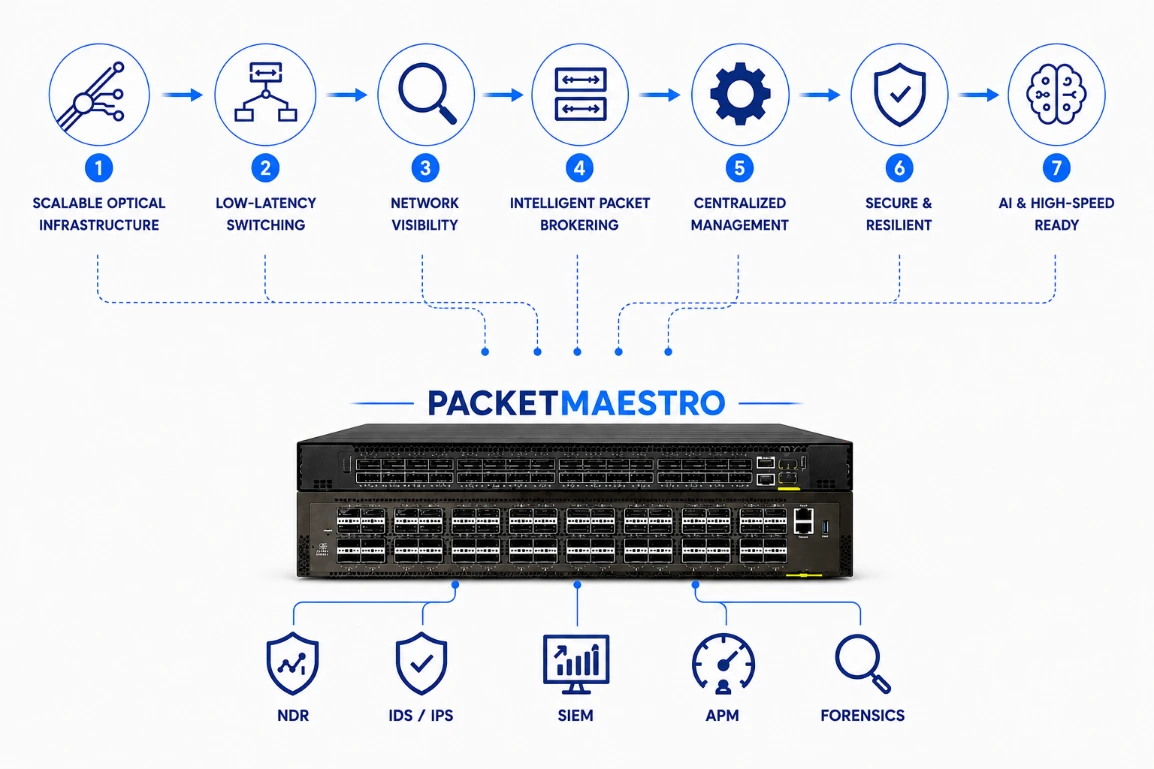
Today's data centers are evolving at an unprecedented pace. Artificial intelligence, cloud-native applications, virtualization, and surging East-West traffic have pushed bandwidth demands higher while shrinking the latency budget. As organizations migrate toward 100G, 200G, 400G, and even 800G Ethernet, simply deploying faster switches is no longer enough.
The real challenge is making sure every packet reaches its destination efficiently while preserving complete visibility, security, and operational resilience. That is where modern connectivity solutions become the foundation of a high-performance data center.
A high-performance network is an integrated stack, not a faster switch.
Start with a Scalable Optical Infrastructure
The physical layer decides how far a network can scale. Modern data centers should adopt structured optical cabling that supports multiple generations of Ethernet without constant recabling. High-density fiber reduces rack space, simplifies cable management, and improves airflow while enabling rapid deployment.
Design the fiber plant around six priorities:
A well-designed optical layer gives you the room to absorb future upgrades with minimal operational disruption.
Design for Low-Latency Switching
With the physical layer in place, switching becomes the performance engine of the data center. Leaf-spine fabrics have become the modern standard because they deliver predictable, non-blocking performance that scales horizontally as you add capacity.
Every leaf connects to every spine, equal-cost and non-blocking
One of the most common design mistakes is treating monitoring as an afterthought. As traffic volumes climb, wiring every appliance directly into production switches quickly stops being practical. Visibility has to be part of the architecture, not bolted on later.
Optical TAPs provide a passive, fail-safe way to capture traffic without adding latency or becoming a point of failure. Unlike SPAN ports, a TAP delivers a complete copy of production traffic even when the network is congested.
Optical TAP
Recommended- Fully passive and fail-safe by design
- Adds zero latency to production traffic
- No packet drops during congestion
- Complete, tap-once packet visibility
SPAN Port
Limited- Consumes switch CPU and backplane
- Drops packets under heavy load
- Limited number of sessions
- Best only for occasional spot checks
The result: monitoring and security tools always receive an accurate, complete copy of production traffic.
Aggregate and Optimize with Intelligent Packet Brokers
A packet broker layer aggregates, filters, and distributes traffic so that expensive monitoring and security tools see only what they actually need. By cutting redundant traffic before it reaches the tools, you maximize the efficiency of every appliance and improve overall network performance.
PacketMaestro
Centralized aggregation, filtering, and distribution for high-speed Ethernet environments.
PacketMaestro-PRO
Extended scale and throughput for the most demanding visibility fabrics.
Centralize Network Operations
Managing dozens or hundreds of switches one device at a time does not scale. A centralized management plane automates the repetitive work and keeps policy consistent across every site.
Automation reduces configuration errors and dramatically accelerates deployment, which becomes essential the moment you operate across multiple sites.
Integrate Security Without Sacrificing Performance
High performance and strong security are not a trade-off. The same visibility data captured by TAPs and packet brokers feeds your detection and response stack with optimized, tool-ready traffic.
Because security appliances receive feeds tailored to their needs instead of competing for switch resources, both detection quality and infrastructure efficiency improve at the same time.
Prepare for AI and High-Speed Ethernet
AI workloads are rapidly reshaping data center traffic. Large GPU clusters generate enormous East-West volumes that demand a purpose-built connectivity foundation:
Organizations planning AI deployments should make sure their connectivity is ready for 400G and 800G today, not after the cluster arrives.
The Build Checklist
When you design your next-generation data center, keep these eight practices on the table:
The Bottom Line
Building a high-performance data center takes more than faster switches. It takes an integrated connectivity architecture, high-speed optical infrastructure, complete packet visibility, centralized management, and scalable open networking, all working as one.
Organizations that invest here gain more than raw bandwidth: greater operational efficiency, stronger security visibility, simpler management, and the flexibility to support whatever comes next.
Combine structured optical connectivity, intelligent packet brokers such as PacketMaestro and PacketMaestro-PRO, and centralized management, and you can confidently build data center networks that are ready for the next generation of digital transformation.
Build Data Center Networks with Confidence
Deliver scalable connectivity, complete visibility, and operational efficiency from day one.
Contact Our Team