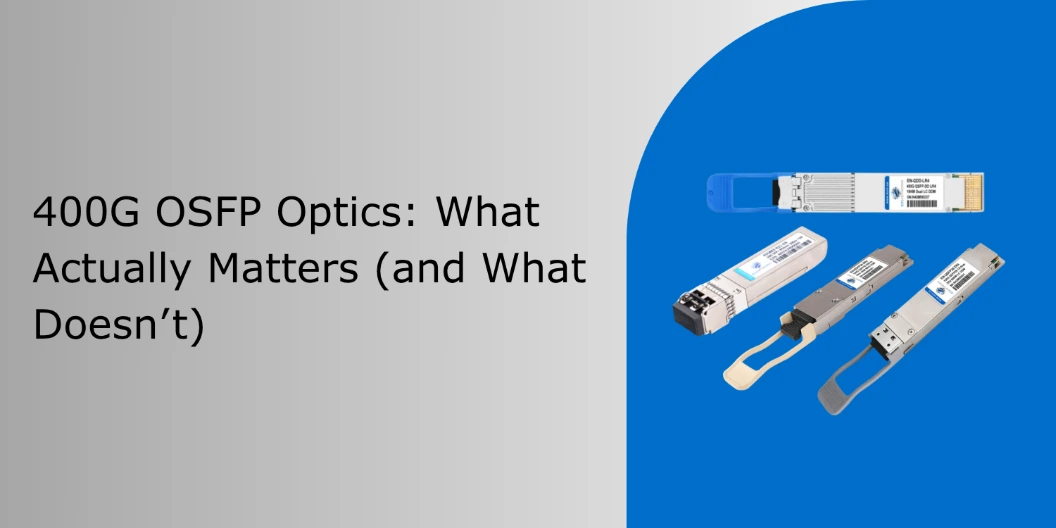
Most 400G discussions are outdated. They focus on form factors, connector types, and standards tables. Modern data centers, especially AI clusters, care about something more practical: efficiency, density, thermal limits, cabling discipline, and the upgrade path to 800G and 1.6T.
400G is not one technology
Yes, many 400G optics are described as 4x100G PAM4. That is technically true, but operationally misleading. A DR4 optic, an FR4 optic, and a ZR optic can all say 400G while creating very different requirements for fiber plant, host power, cooling, and operations.
The useful question is not "OSFP or QSFP-DD?"
It is whether the chosen optic gives you the right reach, connector model, breakout option, thermal margin, and migration path for the network you are actually building.
Power per port becomes a real architecture constraint as optical speeds increase.
LC-only assumptions if breakout, lane reuse, or 800G migration will matter later.
The three rules that actually matter
Flexibility with complexity
If it is MPO, you get breakout and parallel fibers. You also inherit polarity, fiber-count, cleaning, labeling, and operational discipline.
Lane count is not the driver
Teams over-focus on 4x100G versus 8x50G. The real drivers are fiber count, breakout model, power per port, and future upgrade path.
Simplicity with constraint
FR4 and LR4 keep cabling clean and point-to-point. They are easy to operate, but they do not give you the same breakout freedom.
400G OSFP master comparison and breakout matrix
Use this as a practical deployment filter. The right optic is the one that matches reach, fiber type, connector, breakout requirements, and the next migration step.
| Optic type | Reach | Fiber / connector | Breakout | Best fit | What to watch |
|---|---|---|---|---|---|
| 400G SR4 / SR8 | 30m to 100m | MMF, MPO | Strong | Short in-row or rack-adjacent links | Fiber count, polarity, and clean patching discipline. |
| 400G DR4 | Up to 500m | SMF, MPO | 4x100G ready | AI fabrics, leaf-spine, breakout-heavy designs | Powerful option, but not operationally "simple." |
| 400G FR4 | Up to 2km | SMF, LC | None | Clean point-to-point data center links | Simple today, but rigid if breakout is needed later. |
| 400G LR4 | Up to 10km | SMF, LC | None | Campus, metro-adjacent, longer internal links | Choose it for reach, not flexibility. |
| 400G ZR / ZR+ | 80km and beyond | SMF, LC | Coherent | DCI and metro transport | Confirm host support, airflow, and power budget. |
OSFP vs QSFP-DD: be honest about the tradeoff
Most summaries say they are similar, just different sizes. In real deployments, that is too shallow. QSFP-DD is often about compatibility. OSFP is often about performance headroom and future scaling.
| Feature | QSFP-DD | OSFP |
|---|---|---|
| Thermal headroom | More constrained | High |
| Power scaling | Good for many 400G links | Better runway |
| Backward compatibility | Strong | Platform dependent |
| AI / GPU clusters | Works in many designs | Often preferred |
| 800G / 1.6T readiness | Depends on platform roadmap | Designed for scaling |
Choose by deployment path
OSFP plus parallel optics
For dense accelerator clusters, OSFP with DR4 now and DR8 thinking later keeps the physical layer closer to the 800G roadmap.
Use a deliberate mix
FR4 is clean where point-to-point simplicity wins. DR4 belongs where breakout and migration value justify the extra fiber discipline.
- FR4/LR4: simple links, no breakout.
- DR4/SR4: breakout and parallel fiber flexibility.
The MTBF myth
OSFP is not automatically more reliable just because it is OSFP. MTBF is driven by temperature, power, DSP complexity, manufacturing quality, and operating conditions.
Form factor by itself
A better shell cannot overcome poor airflow, high junction temperature, or an overloaded host environment.
Thermal margin
Better cooling can reduce thermal stress, especially in high-density racks, 800G DR8 deployments, and AI fabrics.
The real decision framework
Do you need breakout?
If yes, look at DR4, SR4, or SR8. If no, FR4 or LR4 may be the cleaner operating model.
Do you care more about cabling simplicity?
If yes, LC-based optics are attractive. If flexibility matters more, MPO is worth the operational discipline.
Are you building for AI scale?
If yes, OSFP plus DR4 or future DR8 alignment deserves serious consideration.
Do you want a clean upgrade to 800G?
Avoid designs that make 400G easy today but force a fiber or topology rebuild tomorrow.
Final take
Need more information about 400G OSFP optics?
Talk to E.C.I. Networks about reach, connector choice, host compatibility, fiber plant, and the right path from 400G to 800G.
Contact Our Team