Turning Optical Networking into a Production-Ready Business Asset
As enterprises, service providers, and data center operators continue to modernize their infrastructures, optical connectivity has become a fundamental pillar for delivering high bandwidth, low latency, and scalable network services.
However, deploying optical networking is only the first step. The real challenge lies in transforming a successful deployment into a stable, secure, and fully operational production environment that can support business-critical applications for years to come.
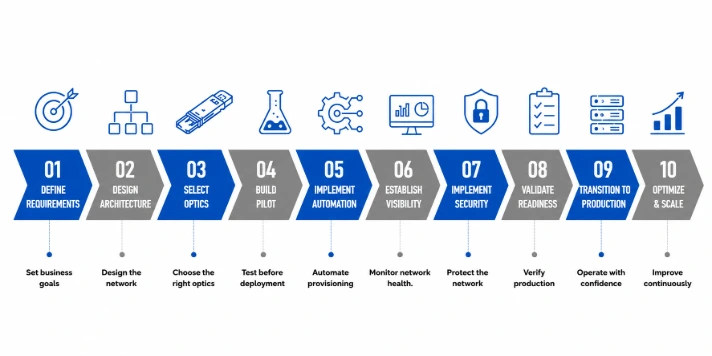
This guide outlines the essential phases required to implement optical connectivity successfully—from planning and deployment to production operations and long-term optimization..
Why Optical Connectivity Matters
Modern networks are experiencing unprecedented traffic growth driven by:
01AI and machine learning workloads
02Cloud computing & multi-cloud architectures
03Data center interconnect (DCI)
04Edge computing
055G and IoT applications
06High-performance computing (HPC)
Traditional copper infrastructure can no longer meet the bandwidth, distance, and energy efficiency requirements of today's environments.
Optical connectivity provides:
✅ Higher bandwidth capacity (100G, 400G, 800G and beyond)
✅ Lower latency
✅ Reduced power consumption per bit transmitted
✅ Greater scalability
✅ Improved network reliability
✅ Longer transmission distances
Choosing optical networking today prepares your infrastructure for tomorrow's bandwidth and scalability demands.
Step 1: Define Business and Technical Requirements
Before selecting any hardware, organizations must establish clear objectives.
Business Questions
- What applications will run across the network?
- What availability requirements exist?
- What future growth is anticipated?
- What is the expected lifecycle of the infrastructure?
Technical Questions
- What bandwidth is required today and in five years?
- What are the distance requirements?
- Is redundancy mandatory?
- Will traffic patterns be east-west, north-south, or both?
Key deliverable:
A documented optical architecture roadmap aligned with business goals.
Step 2: Design the Optical Architecture
Proper design minimizes future operational challenges.
Key components include:
Physical Layer
- Single-mode fiber (SMF)
- Multi-mode fiber (MMF)
- Patch panels
- Optical distribution frames (ODF)
Optical Devices
- Transceivers
- Multiplexers (MUX/DEMUX)
- ROADMs
- Optical amplifiers
Network Equipment
- Core switches
- Spine switches
- Leaf switches
- Routers
Management Layer
- Network Management Systems (NMS)
- Monitoring platforms
- Automation systems
Design Considerations
Consider:
- Link budget calculations
- Fiber attenuation
- Connector losses
- Redundancy models
- Latency requirements
- Power consumption
Step 3: Select the Right Optical Transceivers
Choosing the correct optics is critical.
Common options include:
|
Speed |
Typical Form Factor |
Typical Reach |
Use Case |
|
10G |
SFP+ |
Up to 10 km |
Enterprise access |
|
25G |
SFP28 |
Up to 10 km |
Server connectivity |
|
100G |
QSFP28 |
100 m to 40 km |
Data centers |
|
400G |
QSFP-DD |
100 m to 80 km |
AI and cloud fabrics |
|
800G |
OSFP/QSFP-DD800 |
100 m to 10 km+ |
Hyperscale networks |
Selection criteria:
- Switch compatibility
- Fiber type
- Distance requirements
- Power consumption
- Future scalability
Avoid over-designing or under-sizing the infrastructure.
Step 4: Build a Pilot Environment
Never move directly into production.
A pilot validates assumptions before large-scale deployment.
The pilot should test:
Connectivity
- Link establishment
- Speed negotiation
- Optical power levels
Network Services
- VLANs
- VXLAN
- EVPN
- BGP routing
Timing Services
- Precision Time Protocol (PTP)
- Boundary Clock functionality
Operational Processes
- Provisioning
- Monitoring
- Fault isolation
The objective is to identify issues before they impact production users.
Step 5: Implement Automation Early
Manual optical network management does not scale.
Automation should be introduced from day one.
Areas to automate:
Device Provisioning
- Switch onboarding
- Optical inventory assignment
- Configuration deployment
Monitoring
- Optical power thresholds
- Interface utilization
- Error detection
Change Management
- Configuration backups
- Version control
- Rollback procedures
Common technologies:
- REST APIs
- NETCONF
- gNMI
- Ansible
- Python automation frameworks
Automation significantly reduces operational risk.
Step 6: Establish Comprehensive Visibility
You cannot manage what you cannot see.
Production environments require end-to-end visibility.
Monitor:
Optical Metrics
- Tx optical power
- Rx optical power
- Laser temperature
- Voltage
- Bias current
Network Metrics
- Interface utilization
- Packet drops
- Congestion events
- Latency
Infrastructure Metrics
- CPU utilization
- Memory usage
- Environmental sensors
Modern platforms should consolidate all these metrics into a single operational dashboard.
Step 7: Implement Security Controls
Optical networks are often overlooked in security strategies.
Critical security controls include:
Access Security
- LDAP integration
- TACACS+
- Multi-factor authentication
Network Security
- Role-based access control
- ACL enforcement
- Segmentation policies
Operational Security
- Audit logging
- Configuration change tracking
- Backup management
Security must be integrated into every phase of deployment.
Step 8: Validate Production Readiness
Before going live, execute a production acceptance checklist.
Technical Validation
☑ Redundant links operational
☑ Failover scenarios tested
☑ Monitoring functional
☑ Automation validated
☑ Security policies enforced
Operational Validation
☑ Documentation completed
☑ Escalation procedures defined
☑ Support teams trained
☑ Backup procedures tested
☑ Maintenance windows established
This phase ensures operational confidence
Step 9: Transition to Production Operations
Once deployed, operational excellence becomes the priority.
Production teams should establish:
Daily Activities
- Health monitoring
- Alarm review
- Capacity analysis
Weekly Activities
- Performance reports
- Security audits
- Change reviews
Monthly Activities
- Capacity planning
- Firmware assessments
- Optimization opportunities
Optical networks require continuous attention to maintain optimal performance.
Step 10: Continuously Optimize and Scale
Production environments are never truly finished.
Organizations should regularly evaluate:
Capacity Growth
- New workloads
- AI expansion
- Additional sites
Technology Evolution
- 400G to 800G migration
- Coherent optics adoption
- Energy optimization
Operational Improvements
- Additional automation
- Predictive analytics
- AI-assisted operations (AIOps)
Continuous improvement transforms networking from an infrastructure expense into a strategic business enabler
The Role of Unified Visibility Platforms
As optical infrastructures grow, operational complexity increases significantly.
Organizations benefit from platforms that unify:
- Optical monitoring
- Network management
- Event correlation
- Automation workflows
- Configuration management
- Root cause analysis
Having a centralized view across switches, optical devices, packet brokers, and monitoring systems allows operations teams to reduce troubleshooting time and improve service availability.
Final Thought
Implementing optical connectivity is much more than installing fiber and plugging in transceivers.
Success depends on a structured approach that combines architecture design, validation, automation, security, monitoring, and operational discipline.
Organizations that follow a phased deployment strategy can confidently transition from deployment to production while building an infrastructure capable of supporting AI, cloud, and next-generation digital services.
The future of networking is optical—and the organizations that operationalize it effectively will be best positioned to scale, innovate, and compete.
Implement Optical Connectivity with Confidence
Design, validate, automate, and optimize every stage of your optical network deployment.
Contact Our Team