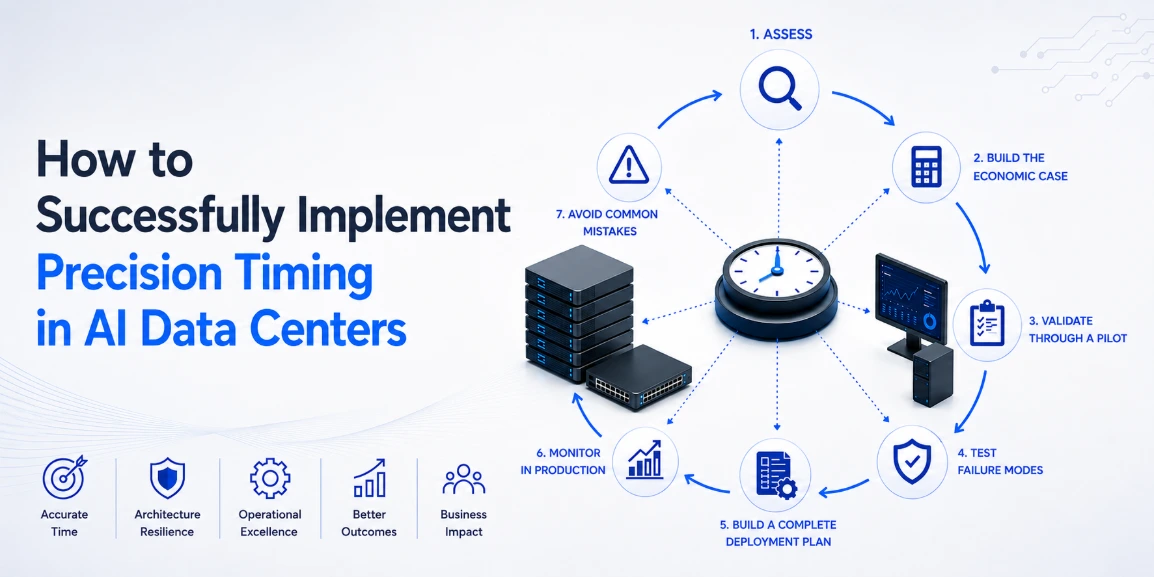
Selecting a timing platform is only the beginning. A dependable deployment starts with a clear operational problem, proves its value under real workload conditions, and stays observable after handoff.
The strongest implementations are selective. They apply tighter synchronization where it changes an engineering outcome, while allowing proven NTP or chrony services to continue supporting the rest of the environment.
The useful question is not how precise the clock can be. Ask how much timing uncertainty the workload can tolerate, how that uncertainty will be measured, and what the team will do when the reference degrades.
Begin with the event, not the clock
Before discussing hardware, document the events that engineers struggle to reconstruct today. Packet loss, storage stalls, GPU communication delays, and security investigations all have different timing needs. The assessment should connect each use case to an observable event duration and a measurable accuracy target.
- Measure the current serviceRecord typical and worst-case offset, reference health, drift, and the differences between server groups.
- Map the consumersConfirm which NICs, switches, operating systems, telemetry tools, and applications can use hardware-assisted timing.
- Review actual incidentsLook for cases where clock uncertainty delayed diagnosis or made event ordering unreliable.
- Name the ownerIdentify who will set policy, approve changes, respond to alarms, and maintain the timing service.
Build the case around time you can recover
A credible business case connects timing to operational loss. Start with the incidents where better event ordering or one-way latency measurement could shorten investigation. Then compare that recoverable value with the full cost of hardware, deployment, monitoring, training, and support.
Value must survive a conservative estimate
If the case works only when every incident is blamed on timing, the case is not ready. Use evidence from real outages and include the probability that tighter synchronization would have changed the diagnosis.
Operational loss: engineering time, affected systems, delayed jobs, and unavailable capacity.
Lifecycle cost: design, implementation, monitoring, documentation, maintenance, and support.
Decision evidence: measured improvement from a representative pilot, not a laboratory specification alone.
Pilot one troublesome workflow
A pilot should answer one operational question well. Choose a workload that represents the production environment, establish the acceptance criteria before deployment, and capture both clock performance and the usefulness of the resulting telemetry.
-
ScopeChoose the incident or measurement that timing must improve.
-
InstrumentMeasure the reference, network path, endpoints, and application view.
-
DisturbExercise failover, reference loss, configuration errors, and path changes.
-
DecideCompare the operational benefit with the complexity of running the service.
A good pilot can support expansion, limit PTP to a smaller precision domain, or show that the current NTP service is already sufficient. All three are useful outcomes.
Break it before production does
Normal operation proves very little about resilience. Commissioning should expose the system to controlled faults and record accuracy, state transitions, alarm delivery, and recovery. Operations needs to know what a failure looks like before that failure happens during an incident.
Treat timing like an infrastructure service
Production readiness requires more than an accurate commissioning result. Timing needs monitoring, change control, escalation procedures, configuration records, and a service owner. It should enter the same lifecycle process used for network, compute, storage, and power infrastructure.
Document the response, not just the threshold. Every alarm should point to an owner, an expected system state, and a practical action. Otherwise monitoring creates noise without improving recovery.
Choose a partner with the tradeoffs in view
E.C.I. NETWORKS supports timing-readiness assessments, architecture design, pilot planning, bills of materials, deployment guidance, and lifecycle operations. The goal is to establish the right level of synchronization for the environment, not to place precision timing everywhere.
That often means strengthening an existing NTP or chrony service first, creating a limited PTP domain for selected workloads, or designing a broader architecture when the operational evidence supports it.

The right implementation isselective, tested, and owned.
Begin with the operational question. Measure the timing service you already have. Prove any change in a representative pilot, test the failed states, and give the production service a clear owner.
Put your timing requirements on solid ground
Talk with E.C.I. NETWORKS about a timing-readiness assessment and an architecture that fits your operating environment.
Talk to a Specialist