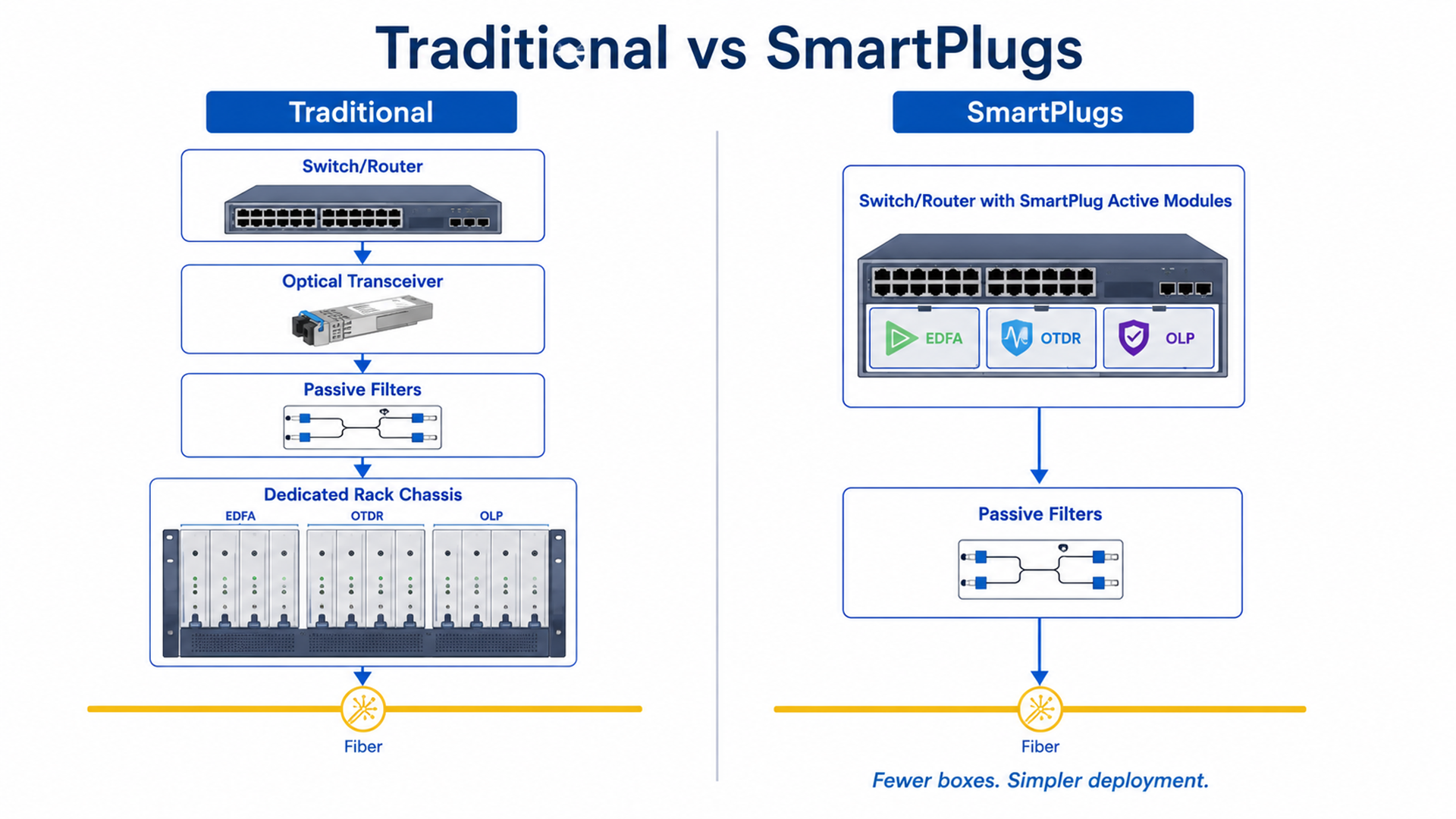
Modern networks need more capacity, better visibility, and faster deployment — without adding more bulky hardware at the edge. That is the idea behind SmartPlugs Transport Solutions from E.C.I. Networks.
SmartPlugs bring key optical transport functions closer to the switch or router by embedding them into compact pluggable modules and passive optical building blocks. Instead of depending entirely on large external optical shelves for amplification, diagnostics, protection, and wavelength management, SmartPlugs enable a more compact and operationally efficient optical edge.
Why Traditional Optical Edge Designs Are Heavy
In most transport and IPoDWDM environments, the optical layer still depends on separate external systems. A typical design includes transceivers, mux/demux filters, amplifiers, OTDR systems, protection shelves, and independent management tooling — each with its own cabling, power draw, and operational domain.
That approach works, but it creates real tradeoffs:
For operators moving toward whitebox, SONiC, and open optical transport, that model is often too large and too complex for edge use cases.
The SmartPlugs Approach
SmartPlugs simplify the optical edge by moving optical intelligence closer to the host platform. The architectural shift is straightforward:
By integrating amplification, diagnostics, protection, and wavelength management into the pluggable layer, SmartPlugs reduce the number of discrete components an operator needs to deploy, cable, power, and manage at each edge site.
The SmartPlug Product Line
SmartPlugs cover the core optical functions operators need at the edge — each one designed to replace a dedicated external box with a compact, pluggable alternative.
Compact Optical Amplification
Delivers optical amplification in a pluggable form factor. Rather than deploying a standalone amplifier chassis, signal boosting is embedded directly at the switch or router port — extending reach without adding shelf space.
Embedded Fiber Diagnostics
Provides on-demand fiber testing — detecting loss, reflections, and faults without requiring a separate OTDR instrument at the site. Diagnostic capability lives at the port, accessible through the host platform.
Optical Line Protection
Supports resilient optical paths by automatically switching traffic to a backup fiber route when the primary path fails. Protection logic is handled in the pluggable layer, keeping recovery fast and the design simple.
DWDM Mux/Demux, Splitters, and Couplers
Compact passive building blocks for wavelength aggregation and space-efficient optical network deployment. Designed to complement the active SmartPlug modules in a coherent edge architecture.
Why It Matters
By consolidating amplification, diagnostics, protection, and wavelength management into the pluggable and passive layers, SmartPlugs give operators a measurably different operational posture at the edge:
Reduced Hardware at Every Site
Fewer boxes, less cabling, and lower power consumption per edge location. SmartPlugs consolidate what used to require multiple rack units into the pluggable layer.
Simpler Deployment and Service Activation
Without a separate optical shelf to install, configure, and integrate, teams can bring up new links faster. Service activation timelines shrink significantly.
Optical Intelligence in the Host Platform
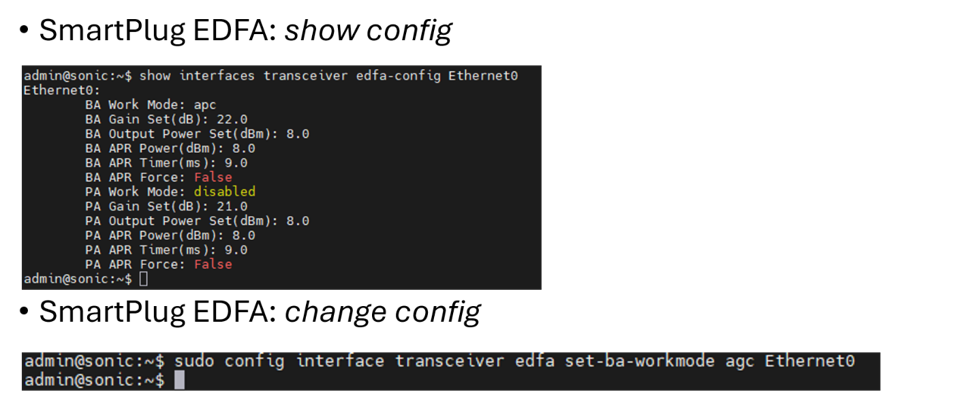
Diagnostics and performance data surface through the switch or router's NOS environment. Optical visibility is no longer siloed in a separate management system.
Final thought
SmartPlugs Transport Solutions simplify the optical edge by integrating key transport functions directly into the pluggable layer. The result is a more compact, efficient, and scalable architecture that reduces complexity while improving operational visibility.
SmartPlugs questions, answered
What problem does a SmartPlug solve?
It moves selected transport functions into a pluggable form factor, reducing the need for a separate optical chassis in suitable edge applications.
Do SmartPlugs replace every transport platform?
No. Traditional chassis remain useful when a site needs broader service density, modularity, protection options or operational features.
Where do SmartPlugs fit best?
They are strongest where space, power and operational simplicity matter and the required service can be delivered within the pluggable design.
What should be confirmed before deployment?
Check host compatibility, service type, reach, optical budget, management, temperature, power and the recovery process for a failed unit.
Build Compact Optical Transport Networks
Reduce footprint, simplify operations, and improve optical visibility with integrated SmartPlugs Transport Solutions.
Contact Our Team