

Specifications
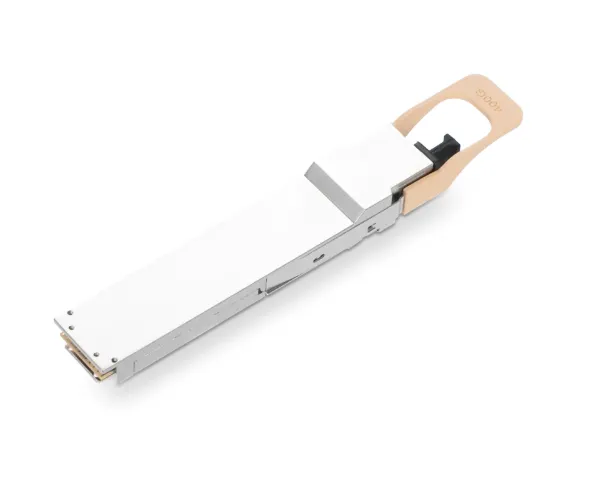
400G OSFP Transceivers for High-Performance Networks
As data centers evolve to support AI workloads, cloud scaling, and high-density architectures, 400G optics remain a foundational building block—even as 800G adoption accelerates.
Choosing the right 400G transceiver is not just about speed. It involves:
- Optical architecture
- Fiber type (MMF vs SMF)
- Connector compatibility
- Breakout capabilities
- Form factor selection (OSFP vs QSFP-DD)
400G OSFP Master Comparison & Breakout Matrix
| Type | Reach | Fiber Type | Optical Lanes | Connector | Polish | Breakout | Matches With |
|---|
| VR4 / VSR4 | 30–50m | MMF | 4 × 100G PAM4 | MPO-12 | APC | 4 × 100G | 100G-SR |
| SR4 | 100m | MMF | 4 × 100G PAM4 | MPO-12 | APC | 4 × 100G | 100G-SR |
| SR4.2 (BiDi) | 150m | MMF | 8 × 50G PAM4 | MPO-12 | UPC | 4 × 100G | 100G-SRBD |
| SR8 | 100m | MMF | 8 × 50G PAM4 | MPO-16 | APC | 8 × 50G / 2 × 200G | 50G / 200G |
| DR4 | 500m | SMF | 4 × 100G PAM4 | MPO-12 | APC | 4 × 100G | 100G-DR |
| DR4+ | 1–2km | SMF | 4 × 100G PAM4 | MPO-12 | APC | 4 × 100G | 100G-FR |
| FR4 | 2km | SMF | 4 × 100G WDM | LC | UPC | ❌ None | 400G-FR4 |
| LR4 | 10km | SMF | 4 × 100G WDM | LC | UPC | ❌ None | 400G-LR4 |
| ZR4 | 80km+ | SMF | 1 × 400G Coh | LC | UPC | ❌ None | DCI |
Key Features
400G Performance
- 4 × 100G PAM4 or 8x50G lanes for high-density data center and AI workloads
Flexible Optics
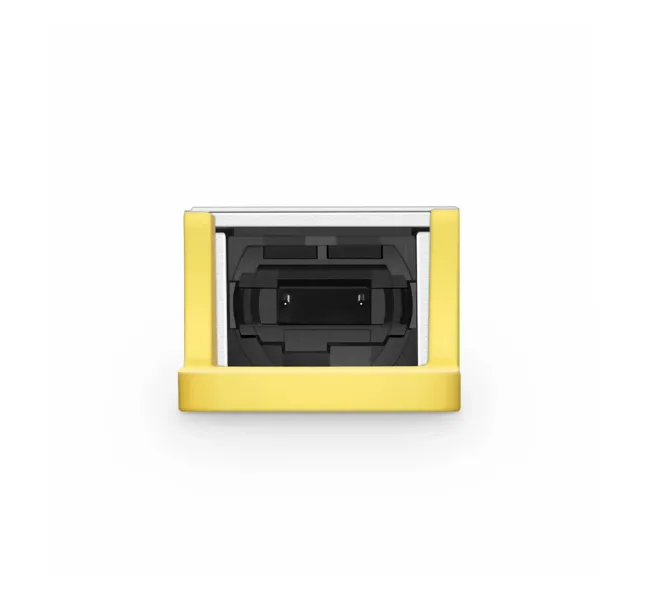
- Supports MPO (DR4/SR4/SR8) for breakout and LC (FR4/LR4) for point-to-point links
Breakout Support
- Up to 4×100G (DR4/SR4) or 2×200G (SR8)
Superior Thermal Design
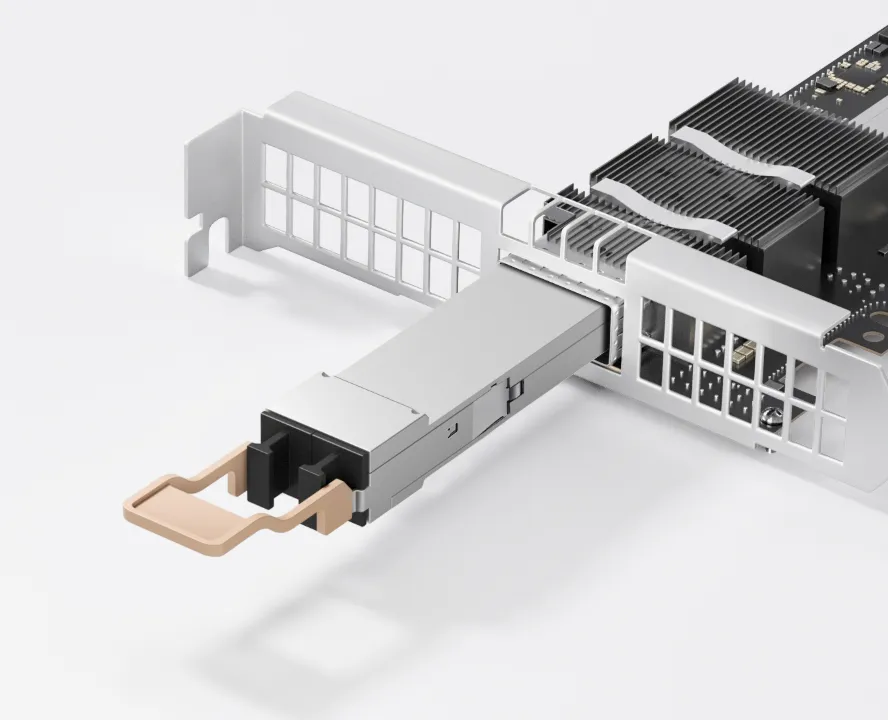
- Higher power handling with integrated heatsink—ideal for high-density and AI environments
Low Power & Low Latency Options
- Available in DSP or LPO for optimized efficiency and performance
Future-Ready
- Designed to scale toward 800G and 1.6T architectures
Wide Compatibility
- Works with leading platforms (Edgecore, UfiSpace, Celestica) and standard IEEE optics
- Temperature: Commercial & Industrial options
OSFP vs QSFP-DD — Which One Should You Choose?
This is one of the most important design decisions—and often misunderstood.
🧠 Key Point
OSFP and QSFP-DD use the same optics (DR4, FR4, etc.) — but differ in size, power, and future scalability.
📊 Side-by-Side Comparison
| Feature | QSFP-DD | OSFP |
|---|---|---|
| Size | Smaller | Larger |
| Cooling | System airflow | Integrated heatsink |
| Power | ~12–18W | ~15–30W+ |
| Backward compatibility | ✔ Yes (QSFP28/56) | |
| AI / Hyperscale | Moderate | Preferred |
| Future (800G / 1.6T) | Limited | Best positioned |
🔍 When to Choose QSFP-DD
- You need backward compatibility
- Enterprise or cloud migration
- Mixed 100G / 400G environments
- Lower power / simpler deployments
👉 Best for:
- Traditional data centers
- Gradual upgrades
🔍 When to Choose OSFP
- High-performance environments (AI / GPU)
- Higher thermal requirements
- Planning for 800G / 1.6T evolution
👉 Best for:
- AI clusters
- Hyperscalers
- High-density fabrics
Applications
Deployment scenarios for this module
Data Center & Enterprise Networks
High-speed connectivity for leaf-spine architectures, server aggregation, and backbone upgrades supporting growing east-west traffic.
Telecom & Service Provider Transport
Robust optical connectivity for aggregation, metro, and long-haul transport across carrier and service provider networks.
Cloud, AI & Hyperscale Infrastructure
Reliable, low-latency links designed for high-performance computing, AI workloads, and scalable cloud environments.
Quality Certification
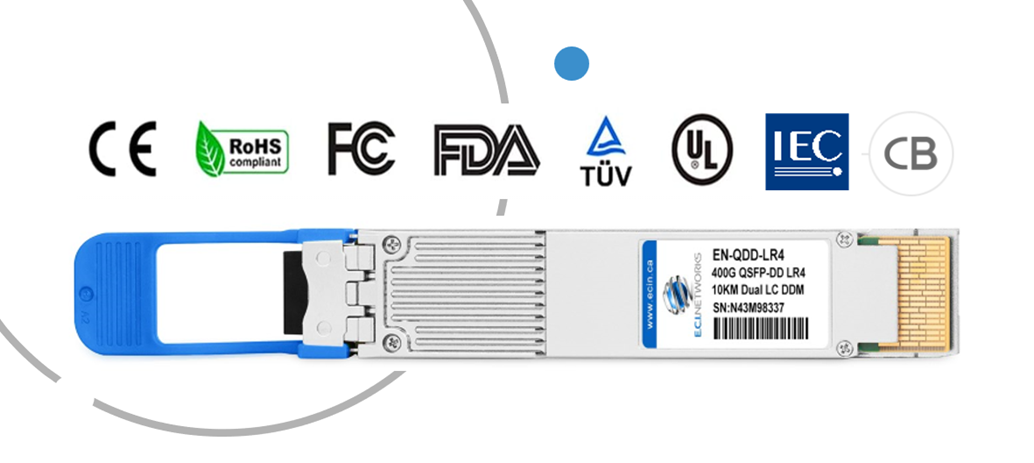
At E.C.I. NETWORKS, all our optical transceivers are CE, FCC, RoHS, and FDA laser compliant, meeting global standards for safety, environmental responsibility, and electromagnetic performance.
Key Certifications
Emissions and immunity compliance for IT and multimedia equipment.
Verified as unintentional radiators with SDoC available.
Safety-certified and laser-classified (Class 1).
U.S. laser safety regulations.
Free from hazardous substances and environmentally responsible.
Available on selected models per regional or customer needs.
Compliance Standards
These certifications ensure our transceivers are safe, interoperable, and built to meet the highest global compliance standards across data center, telecom, and enterprise environments.
Conflict-Free Sourcing
We comply with the SEC Conflict Minerals Rule, supporting ethical sourcing practices for minerals like tantalum, tin, tungsten, and gold.
Quality Certification
At E.C.I. NETWORKS, all our optical transceivers are CE, FCC, RoHS, and FDA laser compliant, meeting global standards for safety, environmental responsibility, and electromagnetic performance.
Key Certifications
Emissions and immunity compliance for IT and multimedia equipment.
Verified as unintentional radiators with SDoC available.
Safety-certified and laser-classified (Class 1).
U.S. laser safety regulations.
Free from hazardous substances and environmentally responsible.
Available on selected models per regional or customer needs.
Compliance Standards
These certifications ensure our transceivers are safe, interoperable, and built to meet the highest global compliance standards across data center, telecom, and enterprise environments.
Conflict-Free Sourcing
We comply with the SEC Conflict Minerals Rule, supporting ethical sourcing practices for minerals like tantalum, tin, tungsten, and gold.
Performance & Reliability
We ensure our optical transceivers deliver exceptional performance and long-term reliability through rigorous testing on industry-leading equipment.
Power & Wavelength Testing
We verify signal strength and wavelength stability to ensure seamless decoding and consistent transmission across the optical path.
Traffic Testing
All transceivers undergo bit error rate (BER) and packet loss testing to guarantee zero data loss and full compliance with Ethernet and Fiber Channel standards.
Optical Performance Validation
Our modules are evaluated for signal integrity, eye diagram clarity, and BER, ensuring stable, high-quality optical transmission in all operating conditions.

End Face Inspection
Each module's fiber interface is inspected and cleaned to eliminate contamination and physical defects - a critical step for optimal signal performance and long service life.
Warranty & Compatibility
Optical Transceivers (1G–400G): Lifetime (5 Years)

Zero Risk
Using our transceivers does not void the warranty of your network equipment. Global OEM policies and consumer protection laws (Magnuson-Moss Warranty Act) prevent manufacturers from denying support based solely on the use of third-party components.
Guaranteed Compatibility
Our modules are coded and tested for seamless operation across major platforms including Cisco, Arista, Juniper, HPE, Nvidia, Huawei, and more. This rigorous validation ensures plug-and-play reliability and full compliance with OEM specifications.
Technical Support & RMA
Have an issue? We provide full technical support and hassle-free RMA on all eligible transceivers. Our team is ready to help with any technical questions about compatibility or deployment. contact our technical support support@ecin.ca
Q&A
Commonly asked questions
No. Under the Magnuson-Moss Warranty Act and similar global consumer protection laws, OEMs cannot void your equipment warranty simply because you use a third-party transceiver. Your equipment warranty remains intact.
Yes. Our OSFP modules can be coded for major OEM platforms (Cisco, Juniper, Arista, Nvidia, etc.) and support open networking environments including SONiC.
A compatible generic version can be provided and coded before delivery.
The difference is in how the module is cooled, not its performance.
-
Fin Top (Finned Top):
Includes built-in heatsink fins and relies on switch airflow for cooling.
👉 Used in most data center switches: Cisco, Arista, etc. -
Flat Top (RHS – Riding Heatsink):
Has a flat surface and relies on the host system’s heatsink for cooling.
👉 Used in servers and high-density AI systems (e.g., GPU platforms).
⚠️ These types are not interchangeable. Using the wrong one can lead to overheating or fit issues.
There is no inherent difference in failure rate (MTBF) between OSFP and QSFP-DD based on form factor alone. Both use similar optical components and technologies.
However, thermal performance plays a key role:
-
OSFP supports higher power and better cooling (larger size, integrated heatsink)
👉 Can result in improved reliability in high-density or high-power environments -
QSFP-DD has a more compact design and relies more on system airflow
👉 Performance is similar, but may be more sensitive to thermal conditions
Yes. Our modules are coded for the specific platform you select at purchase. They are recognized natively by the switch OS without any additional configuration or commands.
No. Our transceivers meet the same IEEE and MSA specifications as OEM modules. They deliver identical optical performance, data rates, and reach characteristics.
Yes. We offer full support, RMA service, and warranty coverage on all modules.
Resources
Downloads and documentation