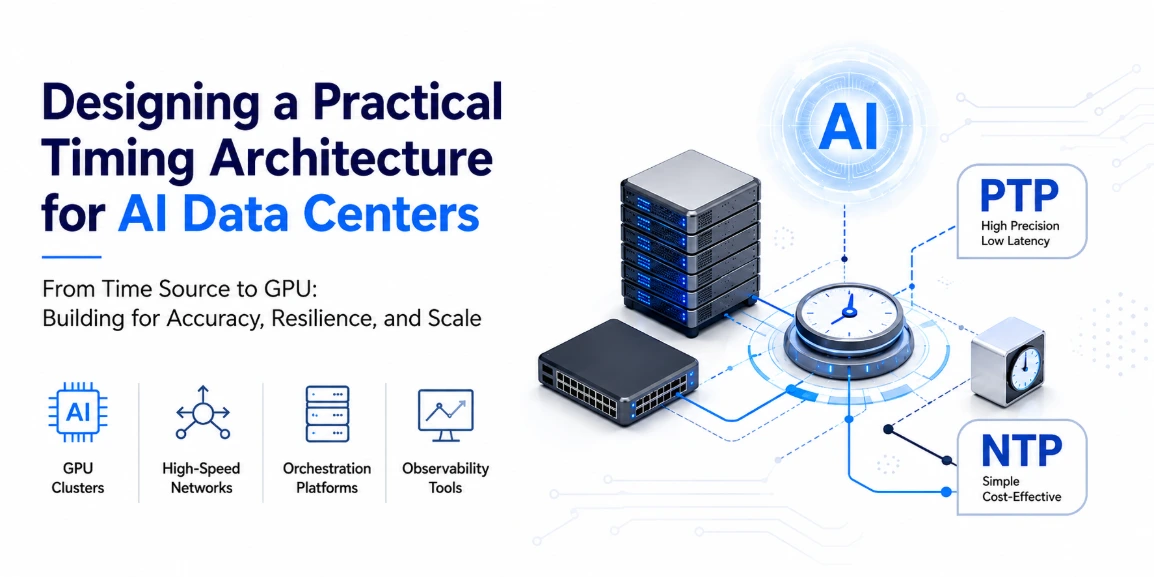
A timing system is only as strong as its complete signal path
Deploying Precision Time Protocol involves more than installing a grandmaster clock. Accurate synchronization depends on every handoff, from the external reference and local oscillator to the network path, endpoint hardware, and monitoring system.
For an AI data center, the practical goal is not the smallest number on a specification sheet. It is a timing service that remains accurate, available, and understandable when the environment changes.
Follow the timing path end to end
Each layer has a distinct job, and each introduces its own failure modes. Treating the architecture as one continuous path makes design reviews and troubleshooting much more effective.
-
Primary reference
GNSS, ePRTC, or another traceable source establishes the time base. Check antenna placement, interference exposure, and reference diversity.
-
Grandmaster clocks
Grandmasters translate the reference into PTP and NTP services. Capacity, profile support, oscillator quality, and failover behaviour matter here.
-
Timing-aware distribution
The switching fabric carries timing traffic through controlled, documented paths. Quality of service and path symmetry affect the result.
-
Boundary and transparent clocks
Timing-aware switches limit accumulated packet delay variation as the network grows. Profile mismatches and incorrect clock roles can undermine the chain.
-
Hardware timestamping and endpoints
NICs, servers, storage, and observability tools consume synchronized time. Confirm that the operating system, driver, and application use the intended clock.
-
Monitoring and management
Operations teams need offset, state, reference health, holdover, and path alarms in one view. A timing fault that cannot be seen cannot be managed.
An excellent grandmaster cannot compensate for a misconfigured boundary clock, an asymmetric fiber path, or an endpoint that timestamps in software.
Design redundancy around failure domains
Timing should receive the same failure-domain analysis as network and power infrastructure. A resilient design separates the elements that can fail together and verifies how the remaining system behaves during the transition.
Use diverse reference inputs where the risk warrants it, and avoid routing every antenna or feed through the same physical path.
Place primary and backup clocks in different racks, power domains, and network attachment points.
Size oscillator performance to the longest credible reference outage, not the average outage.
Alarm on reference changes, clock-class changes, offset movement, and holdover entry before users notice a service problem.
Document how long the system can remain within its accuracy target after losing the reference. That value should be measured during commissioning and tested again after major changes.
Use PTP where precision changes the outcome
Not every workload needs hardware-assisted precision. Scope the service according to the operational question each system must answer, then invest where tighter synchronization improves measurement, diagnosis, or control.
Identity systems, management planes, business applications, scheduled jobs, backups, and most conventional server workloads.
GPU clusters, high-performance storage, network telemetry, packet capture, and systems used for one-way latency measurement.
Trace IDs and logical clocks can establish causality when exact wall-clock agreement is not required. They complement synchronized time rather than replace it.
Start with a defined precision domain. Expand it only when a workload has a clear accuracy requirement and a verified way to consume PTP.
Choose the platform after the architecture
Begin with the accuracy target and the systems that must meet it. Then document scale, interface requirements, reference availability, security controls, and the expected response to failure.
- Accuracy target
- What maximum offset can the workload tolerate, and where will that offset be measured?
- Scale and topology
- How many clients, sites, clock hops, and PTP domains must the design support now and later?
- Reference and holdover
- Is GNSS available and safe to use? How long must the service stay within target after reference loss?
- Network compatibility
- Which PTP profile, multicast or unicast mode, interface speeds, and timing-aware switch features are required?
- Operations
- How will teams monitor offset, clock state, interference, configuration drift, and service history?
Microchip platform fit
E.C.I. Networks is a Microchip partner, so these examples reflect the platforms used in our reference architectures. Buyers should compare them with established alternatives against the same requirements.
Test the system in its failed states
A commissioning plan should measure the timing service during controlled disruptions, record the expected state changes, and confirm that operations receives a useful alarm. Run the same tests after changes to the switching fabric, clock configuration, antenna system, or endpoint software.
Confirm client continuity, selection of the intended backup, the size of the transient offset, and alarm delivery.
Measure holdover performance, clock-state reporting, and the transition back to the reference when it returns.
Verify alternate-path behaviour and watch for asymmetry, unexpected clock hops, or profile changes.
Validate that the NIC, operating system, and application still use the intended time source under load.
A trustworthy timing service does three things during a fault: it preserves synchronization for as long as designed, reports what changed, and gives engineers enough evidence to act.
Turn requirements into a buildable design
E.C.I. Networks helps teams translate accuracy, resilience, and scale requirements into practical timing architectures. That work can include an assessment, pilot plan, architecture review, bill of materials, deployment guidance, and a commissioning test plan.
Whether the next step is a focused GPU-cluster pilot or a production design across several sites, the architecture should make every timing dependency visible before equipment is selected.
Timing architecture questions, answered
What should define an AI data centre timing design?
Application tolerance, event-correlation needs, outage duration and operational ownership should define the architecture before a platform is selected.
Where does PTP belong in the design?
Use PTP where tighter alignment changes an operational or application outcome. NTP can continue serving systems whose requirements it already meets.
What is a timing failure domain?
It is any shared dependency, such as one antenna, reference, power source, grandmaster or network path, whose loss can affect multiple timing clients.
What should commissioning tests prove?
Test reference loss, failover, holdover, path changes, alarm delivery and recovery while measuring the result at representative endpoints.
Plan the Timing Path Before the Purchase
Define the precision domain, resilience model, platform fit, and commissioning tests before equipment is selected.
Talk to a Timing Specialist