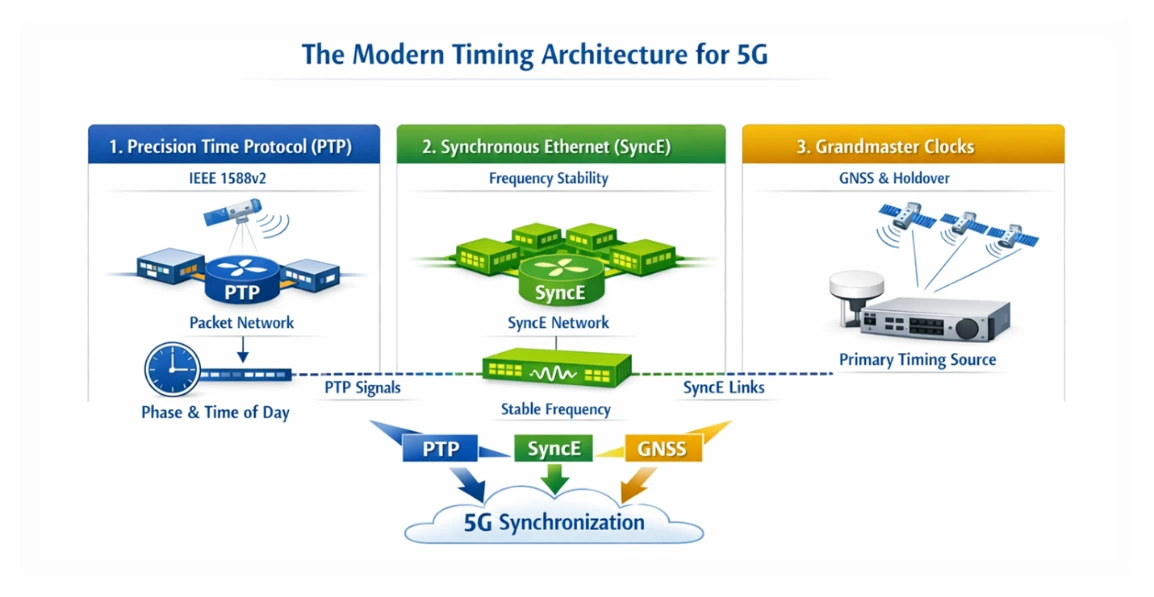
As operators accelerate their 5G rollouts, one question keeps coming up: what replaces the traditional SSU/BITS timing model in a packet-based world? The answer reflects a major industry shift. Synchronization is no longer just about frequency. 5G requires precise frequency, phase, and time-of-day — and that changes everything about how timing is delivered across the network.
What 5G Demands That SSU/BITS Never Had to Deliver
For decades, telecom networks relied on SSU/BITS systems to distribute frequency synchronization over TDM infrastructure. These systems were dependable for SONET/SDH and early mobile generations. But 5G — especially TDD and massive MIMO — introduces timing requirements that legacy SSUs were never designed to meet.
Frequency Only
What SSU/BITS delivered. Sufficient for SONET/SDH and early LTE in FDD configurations.
Phase Alignment
Required for TDD and massive MIMO. Phase errors cause interference between cells and reduce network capacity.
Time-of-Day
Needed for TDD services, coordinated scheduling, and lawful intercept across distributed RAN sites.
5G introduces a dedicated Synchronization Plane (S-plane) that treats timing as its own network function rather than a background utility. This formalizes synchronization as a core service woven throughout the network architecture, not just a supporting feature carried along for the ride.
The Modern Timing Stack: PTP + SyncE + Grandmasters
In 5G, PTP, SyncE, and Grandmaster clocks work as a unified timing stack. The Grandmaster provides the authoritative reference; PTP and SyncE distribute phase, time, and frequency throughout the network. Together, these three technologies form the backbone of modern 5G synchronization.
PTP / IEEE 1588v2
Delivers phase and time-of-day synchronization across packet networks, hop by hop through boundary and transparent clocks.
SyncE
Provides frequency stability over Ethernet physical layers, complementing PTP with a low-noise frequency distribution path independent of packet delay variation.
Grandmaster Clocks
Combine GNSS, PTP, SyncE, and advanced holdover to serve as the single trusted timing reference for the entire network.
How Legacy Timing Maps to Modern Packet Timing
This is not a one-to-one replacement. It is a modernization of the entire timing strategy — each legacy element maps to a packet-native equivalent with broader capabilities and a higher baseline requirement.
| Legacy Element | Modern Equivalent | What Changed |
|---|---|---|
| SSU / BITS | PTP Boundary Clock | Timing is distributed hop-by-hop through packet switches, not centralized TDM shelves. |
| PRC (Primary Reference Clock) | PRTC + Grandmaster | Now delivers frequency, phase, and time-of-day — not frequency alone. |
| TDM timing distribution | PTP + SyncE | Packet-based timing with multi-dimensional synchronization over standard Ethernet infrastructure. |
| Stratum hierarchy | PTP clock classes | More dynamic, GNSS-aware, and optimized for packet network behavior and holdover recovery. |
Why SSU Replacement Can't Wait
Many operators delayed SSU replacement during early LTE and VoLTE rollouts because frequency-only timing was still workable. That flexibility no longer exists in 5G. Phase errors translate directly into poor user experience at the edge, interference between adjacent cells, and degraded overall network capacity.
With the S-plane now a formal part of the 5G architecture, timing has moved from background infrastructure to a front-line network function. Operators that modernize early consistently see smoother 5G rollouts and fewer RAN performance issues at launch.
Timing Accuracy Is a Competitive Advantage
In 5G TDD, nanosecond-level phase alignment directly impacts cell capacity, inter-cell interference, and the quality of edge services.
Migration Roadmap: From SSU to Packet Timing
Most networks do not transition directly from SSU-based timing to full packet-based synchronization overnight. Operators typically adopt a hybrid timing architecture that can persist for several years, evolving in well-defined phases.
Deploy PRTC-Class Grandmasters at Core and Aggregation Sites
Establish a highly accurate and resilient timing foundation. Microchip's TP4100 and TP4500 are well suited for this role, delivering carrier-grade performance and scalability for modern packet networks.
Enable SyncE and PTP in the Transport Network
Upgrade routers and switches to support Synchronous Ethernet and IEEE 1588 PTP — including boundary clock and transparent clock functionality — to ensure accurate time distribution across the packet network.
Replace SSU Fan-Out with Packet-Aware Timing Shelves
Introduce packet-aware timing shelves or extension units to support remaining TDM infrastructure during the transition. Microchip's TimeProvider XT (TPXT) offers a low-disruption path to retire SSUs while still delivering legacy T1/E1 outputs where they are still needed.
Extend PTP Deeper Into the RAN Edge
Push timing further into the network to reach DU/CU sites and small cells, where precise synchronization is most critical for 5G performance and spectrum efficiency.
Decommission Legacy SSU/BITS
Once TDM dependencies are fully eliminated, legacy SSU/BITS equipment can be safely decommissioned — completing the transition to a fully packet-based timing architecture.
The Bottom Line
Need more information about your timing infrastructure?
Talk to E.C.I. Networks about modernizing your timing infrastructure with PTP, SyncE, and Grandmaster solutions designed for the transition from legacy SSU/BITS to scalable 5G packet-based synchronization.
Contact Our Team