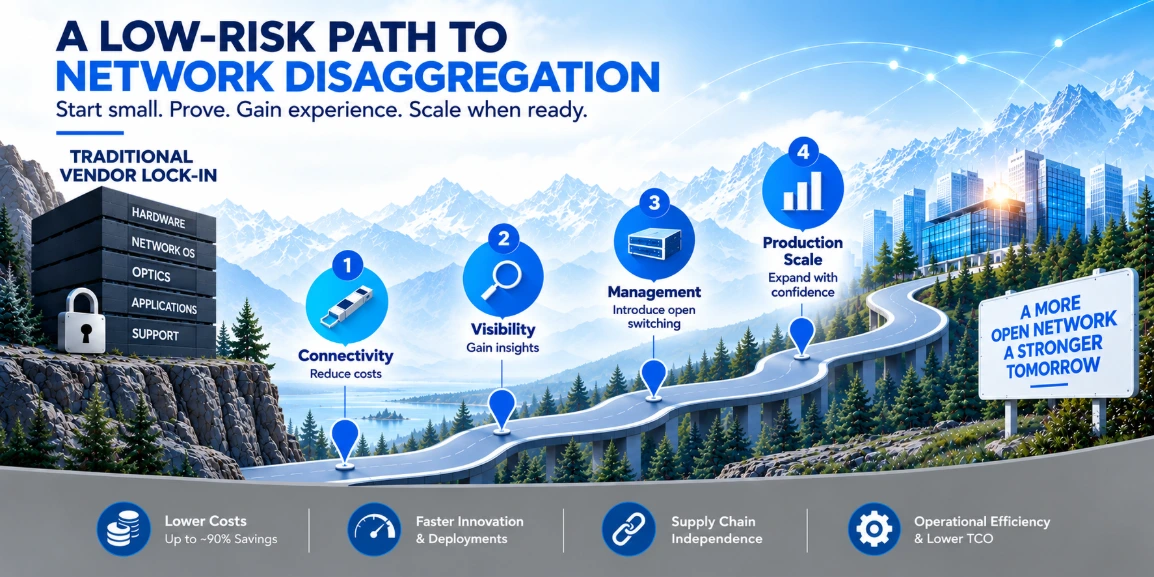
Start Saving from Day One. Open Your Network One Step at a Time.
Open networking does not require replacing your entire network.
For many organizations, the easiest place to start is much simpler: one connection.
Qualified third-party optical transceivers and cables can significantly reduce connectivity costs while allowing existing switches, network operating systems and network architectures to remain in place.
That means the open-networking journey can deliver TCO savings from Day One, before a customer replaces a single switch.
From there, organizations can progressively introduce disaggregation through network visibility, gain operational experience with open switching in management networks, and expand into production switching only when the operational and economic case makes sense.
At E.C.I. NETWORKS INC. (ECIN), we describe this journey as:
Connectivity → Visibility → Management → Production
SAVE & PROVE → EXPERIENCE → OPERATE → SCALE
The principle is simple:
Don’t start with the spine. Start with one connection.
Not every organization needs to complete all four steps. Each stage can deliver value independently, and the customer decides how far — and how fast — to go.
What Is the Best Way to Start With Open Networking?
A low-risk path is to begin with qualified third-party optics and cables on existing switches, where organizations can reduce connectivity costs without changing the network architecture. From there, teams can gain hands-on experience with disaggregation through out-of-band network visibility, introduce a supported SONiC distribution in management or lab environments, and move into production ToR, Leaf and Spine roles only when the operational and economic case supports it.
In short:
Save first. Prove interoperability. Gain experience. Build operational confidence. Then scale when ready.
What Is Open Networking?
Open networking separates components that have traditionally been purchased as an integrated system from a single networking vendor.
Depending on the architecture, organizations can gain greater freedom to select:
Hardware + Network OS + Optics + Applications + Support
from different suppliers based on interoperability, performance, operational requirements and economics.
The objective isn’t simply to replace one networking vendor with another.
The objective is to give the network operator greater control over the architecture — and make that control incremental rather than all-or-nothing
1. Unlock Connectivity — SAVE & PROVE
What Is the Easiest Way to Start With Open Networking?
For many organizations, the simplest first step isn’t replacing a switch.
It’s replacing an optic.
The existing switch remains.
The NOS remains.
The network architecture remains.
Instead of purchasing optical transceivers, DACs and AOCs exclusively from the switch manufacturer, organizations can evaluate qualified third-party alternatives.
This can create an immediate economic benefit.
Start Saving from Day One
OEM optics can represent a significant portion of network infrastructure cost, particularly as networks scale to 25G, 100G, 400G and beyond.
Qualified third-party optics can often be sourced at substantially lower cost than OEM-branded equivalents.
This means organizations don’t need to wait for a SONiC migration or data-center refresh to begin realizing the economic benefits of a more open network.
The savings can begin with the first deployment.
The basic arithmetic is straightforward:
Savings per optic × Number of interfaces = Potential connectivity CAPEX reduction
Those savings can then scale across:
Switch → Rack → Row → Data Center → Multi-Site Network
Actual savings depend on the OEM, optical specification, reach, speed, volume, support requirements and negotiated OEM pricing.
A complete TCO analysis should therefore consider acquisition, deployment, sparing, operations, support and lifecycle costs — not simply the purchase price of the optic.
SAVE — Then PROVE
Connectivity is an attractive first step because it accomplishes two things:
Reduce TCO.
And:
Prove the supplier.
A single third-party optic doesn’t prove that your entire architecture is vendor-independent.
It proves something more practical.
It allows you to evaluate whether the supplier can correctly support your environment:
- Was the optic coded correctly for the platform?
- Does it operate correctly with the deployed NOS version?
- Does DOM/DDM work correctly?
- Does the link remain stable?
- Can the supplier help troubleshoot interoperability issues?
- Can the supplier deliver consistently?
- What happens when something fails?
Those are valuable questions to answer before trusting a supplier with increasingly important parts of the network.
One Connection Proves. One Build Saves.
These are different objectives.
One connection proves.
A small deployment can validate coding, interoperability and supplier responsiveness.
One build saves.
A new rack, leaf-and-spine expansion or scheduled refresh can involve dozens — or hundreds — of optical interfaces.
At that point, connectivity savings can become material enough to affect the business case for the entire project.
Start with the first. Model the second.
Are Third-Party Optical Transceivers Safe to Use?
Price alone should never determine optical-transceiver selection.
Qualified optics should be evaluated against:
- MSA compliance and applicable IEEE specifications
- Platform compatibility and correct coding
- NOS/software version
- Connector and fiber type
- Required reach
- Optical link budget
- Breakout support
- DOM/DDM functionality
- Operating temperature
- Power consumption and thermal profile
- Lead time and availability
- Support and interoperability evidence
This is where qualification and engineering matter.
ECIN’s approach isn’t simply:
Buy a cheaper optic.
It is:
SAVE & PROVE — reduce connectivity cost while proving independently sourced components in your environment.
Do Third-Party Optics Affect Switch Warranty or Support?
Using a third-party optic does not automatically mean the switch warranty is void. Warranty and support handling can vary by manufacturer, platform and support agreement, so the specific OEM policy should always be reviewed.
The more practical consideration is often support scope during troubleshooting.
Some OEM support organizations may ask the customer to substitute an OEM-branded transceiver while investigating a connectivity problem.
That possibility can be planned for.
For example, organizations may retain a small quantity of OEM optics for troubleshooting and escalation while using qualified third-party optics across the broader deployment.
The important point is to understand the support model before deploying at scale, not during an outage.
Stage 1 outcome: immediate savings with minimal architectural change.
2. Unlock Visibility — EXPERIENCE
Once interoperability has been proven at the connectivity layer, the next step can be gaining hands-on experience with a genuinely disaggregated platform..
A traditional network packet broker may combine hardware, packet-processing software, optics and support into one proprietary platform. With PacketMaestro, those layers can be separated
PacketMaestro aggregates, filters and distributes traffic from TAP and SPAN sources toward security, monitoring and performance-analysis tools. This gives network engineers practical experience deploying, configuring, monitoring, upgrading and troubleshooting a disaggregated platform — without beginning with the production switching fabric..
Because it allows engineering teams to answer the operational questions that determine whether disaggregation actually works for them
- Can we deploy it?
- Can we configure it?
- Can we monitor it?
- Can we automate it?
- Can we upgrade it?
- Can we troubleshoot it?
- Can we support it?
Once those questions have been answered through experience rather than a vendor presentation, open networking becomes much less theoretical.
What Is the Risk of a Disaggregated Packet Broker?
TAP and SPAN sources normally provide copies of production traffic.
An out-of-band packet broker therefore isn’t carrying the production packets themselves.
If the packet broker fails, production traffic continues.
But that doesn’t mean there is no risk.
The primary risk is a monitoring gap.
A failed broker or incorrect filter could prevent an IDS, NDR, packet-capture or performance-monitoring system from receiving the traffic it expects.
That risk can be managed by:
- Running the new platform in parallel during migration
- Starting with lower-consequence monitoring applications
- Validating filtering and steering against known traffic
- Monitoring packet-broker ports and system health
- Migrating compliance or critical security feeds only after validation
Inline deployments have a different risk profile because they enter the forwarding path and should be treated separately.
Stage 2 outcome: practical experience with disaggregation without starting in the production switching fabric.
3. Unlock Management — OPERATE
How Can You Introduce SONiC Without Starting in Production?
The next step introduces actual open switching.
But you still don’t need to start with the production spine.
An out-of-band management network, lab or staging environment can provide a practical environment for introducing SONiC and open switching hardware.
Engineering teams can gain experience with:
- SONiC operation
- Open switching platforms
- APIs and configuration management
- Automation
- Monitoring and telemetry
- Software upgrades
- Troubleshooting
- Support and escalation
Which SONiC Are We Talking About?
This distinction matters.
SONiC isn’t one commercial product.
Community SONiC and supported commercial distributions differ in qualified hardware, release lifecycle, feature packages, upgrade tooling and support.
ECIN’s Ready-to-Plug switches are currently based on the Broadcom SONiC distribution, with the Broadcom SONiC Enterprise Base package available preloaded on supported platforms.
ECIN’s Ready-to-Plug offering includes maintenance and support, access to ECIN network engineers and Level 3 support from Broadcom. Premium 24x7 support is also available as an option.
ECI Ready-to-Plug SONiC Switches v4.0.docx
The portfolio includes management-switch platforms as well as data-center platforms for ToR, Leaf, Spine and Superspine roles.
ECI Ready-to-Plug SONiC Switches v4.0.docx
Feature availability still depends on the platform, ASIC and SONiC package.
Capabilities such as EVPN/VXLAN, telemetry and PTP should therefore be validated against the qualified hardware and software release rather than assumed simply because a platform runs SONiC.
Can SONiC Be Used for Out-of-Band Management?
Yes, on qualified platforms.
ECIN’s Ready-to-Plug portfolio includes management-switch configurations designed around 1G connectivity with higher-speed uplinks, providing a practical entry point for open switching.
ECI Ready-to-Plug SONiC Switches v4.0.docx
A lab or staging environment is another valid starting point.
As operational experience grows, the question changes from:
“Can we operate an open network?”
to:
“Where should we deploy it next?”
Stage 3 outcome: operational experience with supported open switching before production migration.
4. Unlock Production — SCALE
How Do You Move Open Networking Into Production?
By this stage, the organization has already:
Proven interoperability
Experienced disaggregation
Operated open switching
There is still no requirement to replace an entire data center.
Production adoption can begin with a new project, new workload, single rack or scheduled refresh:
One Rack → ToR → Leaf → Spine → Fabric
From there, open networking can expand into:
- 25G/100G server connectivity
- 100G/400G switching
- 800G as platforms and optics qualify
- EVPN/VXLAN
- Open optics throughout the fabric
- Automation
- Telemetry
- Data-center fabrics
ECIN’s current Ready-to-Plug SONiC portfolio spans speeds from 1G through 800G and includes data-center platforms intended for Leaf, ToR, Spine and Superspine applications.
ECI Ready-to-Plug SONiC Switches v4.0.docx
Where Does Open Networking Fit in AI Data Centers?
Selectively.
GPU back-end fabrics are frequently purchased and deployed as validated architectures where switches, adapters, cabling, topology and software are engineered together.
That may not be the ideal environment for an organization’s first open-networking deployment.
Open components can, however, fit naturally around accelerated infrastructure:
- Front-end networks
- Storage networks
- Management networks
- High-speed optical connectivity
- Network visibility
- Monitoring and telemetry
- Timing and synchronization
The objective isn’t openness for its own sake.
It’s using openness where it improves economics, flexibility or operational control without introducing unnecessary risk.
What Are the Risks and Costs of Open Networking?
Open networking doesn’t eliminate cost.
It changes where some of the cost resides.
Skills
Open platforms can require greater familiarity with Linux, APIs, automation and configuration management.
Organizations may need to develop those skills internally or obtain them through a supported integration model.
Qualification and Integration
Hardware, NOS releases, optics and required features need to be validated together.
That work is real and needs to be considered when comparing architectures.
Multi-Vendor Troubleshooting
More suppliers can create more boundaries during troubleshooting.
Determining whether a problem originates in hardware, NOS, optics or configuration can require coordination.
That’s why an integration and escalation model becomes particularly important in a disaggregated architecture.
Sparing and Lifecycle
Independent components may have independent lifecycle and upgrade schedules.
Inventory and lifecycle planning therefore remain important.
Lab and Testing
A progressive deployment model assumes somewhere to validate changes before production.
If that capability doesn’t exist, building it should be included in the adoption plan.
When Should You Stop?
Stopping is a legitimate outcome.
Open networking isn’t successful only when every switch has been replaced.
Stop After Step 1
If your main objective is connectivity cost reduction and your existing network architecture is meeting your needs, Open Connectivity may be enough.
You can continue realizing substantial optics savings without changing your switching architecture.
Stop After Step 2
If you want the economic and operational benefits of disaggregation in network visibility but don’t want to change production switching, Open Visibility may be the right destination.
Continue to Steps 3 and 4
Move further when your organization has — or intends to develop — the operational capabilities required for open switching and when the economics, flexibility or architectural benefits justify the change.
The customer controls the pace.
From Vendor-Controlled to Customer-Controlled
This is the larger transformation behind the four steps.
In a vertically integrated architecture, many decisions move together:
Hardware + NOS + Optics + Applications + Support
Disaggregation creates the opportunity to make more of those decisions independently.
That creates competition.
Competition can reduce cost.
Interoperability creates choice.
Choice can reduce dependency.
And operational experience gives organizations the confidence to determine how far they want to go.
Dependency doesn’t disappear completely.
It becomes divisible.
An optic supplier can potentially be changed without replacing the NOS.
Hardware can potentially change without replacing packet-broker software.
Applications can evolve independently from the underlying switch.
That’s the point.
Open networking isn’t simply about changing vendors. It’s about changing who controls the architecture.
Why Do Network Visibility and Open Networking Need Accurate Time?
As infrastructure becomes more distributed, knowing what happened isn’t always enough.
Engineers also need to know:
When did it happen?
And:
In what order?
Packet captures have timestamps.
Logs have timestamps.
Telemetry has timestamps.
Security events have timestamps.
If the clocks producing those records disagree, reconstructing events across servers, storage, switches and security tools becomes more difficult — particularly during an incident.
This connects open networking and network visibility directly to the third ECIN story:
Trust Every Second.
Do Modern Data Centers Need PTP?
Not always.
A properly engineered NTP architecture remains appropriate for many enterprise and data-center applications.
Precision Time Protocol — PTP / IEEE 1588 — should be considered when the application requires accuracy beyond what the existing timing environment can reliably provide.
Examples include:
- One-way latency measurement
- Distributed event correlation
- Regulatory timestamping
- AI/HPC troubleshooting
- Distributed application tracing
- High-precision event ordering
A practical approach is:
Deploy the precision the application requires, where it requires it.
Why Does Your Switch Choice Affect Timing Later?
High-precision PTP generally depends on hardware timestamping and timing-aware network infrastructure.
Achievable accuracy depends on endpoint hardware, switch behavior, topology, path asymmetry, PTP profile and overall timing design.
For applications requiring very precise synchronization, these details must be validated as part of the architecture rather than assumed simply because a platform lists PTP support.
This matters during the open-networking journey because PTP capabilities vary by platform, ASIC and SONiC distribution.
ECIN’s Broadcom SONiC portfolio, for example, includes Linux PTP/KNETSync in certain advanced packages, reinforcing why the required timing features should be evaluated against the specific hardware and SONiC package being selected.
ECI Ready-to-Plug SONiC Switches v4.0.docx
Even if you don’t need PTP today, it is worth asking during platform qualification:
Does this platform support the timing architecture we may need tomorrow?
TRUST EVERY SECOND
What Does a Phased Open Networking Migration Look Like?
Don’t Start With the Spine
Open networking doesn’t need to begin with the most mission-critical part of your infrastructure.
LOW RISK→ MISSION CRITICAL
CONNECTIVITY → VISIBILITY → MANAGEMENT → PRODUCTION
SAVE & PROVE → EXPERIENCE → OPERATE → SCALE
The journey can happen over months or years.
Or it can stop after Step 1.
The customer sets the pace.
Start Small Before You Scale
Begin with one connection, prove interoperability, gain hands-on experience with disaggregation, and expand into open switching only when the operational and economic case makes sense.
Contact our Team