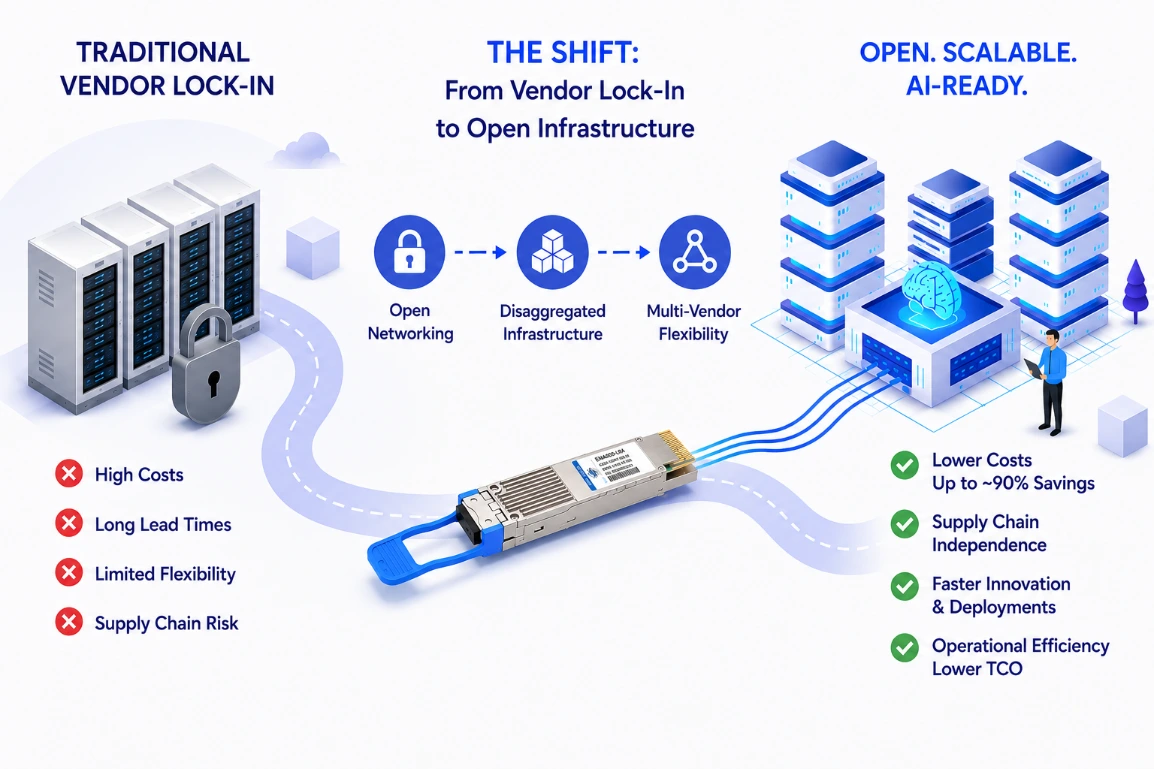
AI workloads, high-performance computing, and cloud-scale infrastructure are pushing networks beyond traditional limits. In this environment, the old OEM-centric model for optics is no longer sustainable. Forward-looking organizations are making a strategic shift toward third-party compatible optics — and it goes well beyond cost savings.
From Vendor Lock-In to Open Infrastructure
Traditional networking was built around single-vendor ecosystems, proprietary hardware, and limited flexibility. Modern architectures — especially in AI and data centers — are moving in the opposite direction. Optics are one of the first and easiest layers of the stack to open.
OEM-Centric Infrastructure
- Single-vendor ecosystems with constrained sourcing
- Proprietary lock-in across every layer of the stack
- Long lead times and supply chain vulnerability
- High margins with limited competitive pressure
Open, Multi-Vendor Infrastructure
- Disaggregated architecture with flexible sourcing
- MSA-compliant optics with broad compatibility
- Multiple supply paths and faster availability
- Competitive pricing and strategic flexibility
AI Is Rewriting the Optics Equation
AI clusters demand massive bandwidth, ultra-low latency, and high-density deployments. In these environments, optics are no longer a small line item — they are a major scaling factor. At AI scale, the difference between OEM and third-party pricing compounds across thousands of links, every upgrade cycle, and every new site.
Using OEM optics at AI scale means high costs, long lead times, and disappearing flexibility. Third-party optics change the math: costs drop meaningfully, deployments accelerate, and scaling becomes operationally practical.
Five Reasons Leading Organizations Are Switching
Cost is the entry point for most conversations, but it is rarely the only driver. Here is what actually moves the decision at the organizational level.
Scalability Without Cost Explosion
AI and cloud environments scale rapidly and unpredictably. Third-party optics let organizations expand capacity and upgrade speeds without each step triggering a significant budget event. The economics of growth improve meaningfully across the infrastructure lifecycle.
Supply Chain Independence
Over-reliance on a single OEM vendor became a visible operational risk in recent years. Third-party optics restore optionality — multiple sourcing paths, faster availability, and the ability to respond when supply is constrained without stalling deployment timelines.
Multi-Vendor Interoperability
Modern networks span SONiC-based switches, open hardware platforms, and multiple vendors running in parallel. MSA-compliant third-party optics integrate cleanly across this landscape without requiring a uniform hardware stack or additional vendor negotiation.
Faster Innovation Cycles
OEM ecosystems often lag when new form factors and higher speeds emerge. Third-party vendors move faster, support emerging technologies sooner, and give operators access to 800G and 1.6T earlier in the product cycle — before OEM pricing stabilizes.
Operational Efficiency
Easier sparing, faster hot-swap replacement, and a lower total cost of ownership add up across a large fleet. Operations teams spend less time managing optics procurement and more time running and scaling the network itself.
Addressing the Remaining Concerns
Even as adoption grows, some hesitation persists. These are the most common questions and the honest answers.
Optics as a Strategic Lever
Most organizations still treat optics as a commodity line item — something to procure at the lowest available price and move on. The organizations pulling ahead treat them differently.
Leading data center and AI infrastructure teams think about vendor independence, scaling economics, and upgrade paths at the same time they plan topology and switching. That perspective shift is what separates a network that can scale fast and adapt from one that is always negotiating its way to the next upgrade.
The question is no longer whether to use third-party optics. It is how quickly you can structure the transition and take full operational advantage of it.
E.C.I. Networks is built for this model. We provide high-performance, MSA-compliant optics with broad compatibility across AI, data center, and telecom environments — backed by proven reliability and a partner-focused support model that treats your network as the product, not the sale.
The Bottom Line
If you're planning your next network upgrade, AI deployment, or data center expansion:
Our team specializes in designing, optimizing and future-proofing network infrastructures
Contact Our Team