A network can keep running while its clocks quietly drift out of agreement.
Canada’s critical infrastructure depends on positioning, navigation and timing, or PNT. GPS is one of the satellite systems that supplies these services. Even a network that never moves may rely on satellite signals to keep its clocks aligned.
For operators, resilience begins with a practical question: what happens to the service when its source of time becomes unavailable or unreliable?

A national priority, an operational responsibility.
On October 22, 2026, the Government of Canada announced its first PNT Resilience Framework. It brings renewed attention to the infrastructure that depends on satellite navigation and timing.
Mobile networks need synchronization. Utilities align measurements and fault records. Financial institutions need reliable transaction timestamps. Transportation and emergency services depend on accurate navigation as well as time.
The framework sets a national direction. The engineering work still happens at each site: identify dependencies, establish acceptable timing error, and decide how the service should behave during disruption.
It is not a requirement to buy a particular product. It is a reason to review whether existing redundancy covers the failures that matter to your operation.
Losing the signal is only one failure mode.
GNSS signals arrive at very low power. Interference, solar activity, antenna faults and damaged cables can interrupt reception. A misleading signal creates a different problem: the receiver may still appear to be working.
When the reference disappears
Jamming can prevent a receiver from tracking satellites. An antenna or power fault can have a similar operational effect. The clock needs a trusted alternative or a defined period of holdover.
When the reference misleads
Spoofing can introduce false position or time information. Signal availability alone is insufficient; monitoring must also look for inconsistencies and unexpected changes in the reference.
A second receiver can share the same vulnerability.
Two grandmasters with separate antennas may both experience the same interference. Another constellation can help with some faults, but nearby GNSS receivers still share an exposed radio environment. Trace each backup to its origin before calling it independent.
Design what happens between loss and recovery.
The useful measure of resilience is the time delivered to the application throughout a disruption. Detection, source selection, holdover and recovery all affect that result.
The clock’s response
Illustrative timing pathTracking a trusted reference. The clock uses a validated external reference to discipline its oscillator. Monitoring watches for changes in signal quality and time agreement.
Bridging the interruption. If the reference is lost or rejected and no trusted alternative is available, the clock relies on its local oscillator. Time error must remain within the service’s limit.
Returning with care. Validate the returning reference before selecting it. Check that reacquisition and any correction to the clock do not disrupt dependent applications.
This example shows local holdover. A deployment may also select an independent external reference, where one is available and validated.
Holdover buys time. Define how much you need.
A clock in holdover uses its oscillator to maintain timing without a trusted external reference. Its useful duration depends on the application’s error tolerance, the oscillator, temperature, aging and how well the clock was synchronized beforehand.
How long can this service remain within its timing limit after the reference is lost?
OCXO, rubidium and cesium technologies offer different stability characteristics. A stable frequency does not, by itself, guarantee that time of day remains within the required limit. Evaluate the complete timing system under the conditions it will actually face.
PTP can distribute time and phase across a packet network. SyncE distributes frequency, not time of day. Their value as backup paths depends on the independence of the upstream reference and the resilience of the network carrying it.
Give each layer a clear job.
Microchip’s timing portfolio covers complementary roles. Select the combination against your requirements for accuracy, holdover, network profiles, monitoring and recovery.
- Assess the reference
- BlueSky GNSS Firewall monitors for GNSS anomalies and can protect downstream equipment from suspect signals. SkyWire capabilities support comparisons between geographically separated clocks. Detection still needs a defined fallback response.
- Deliver time
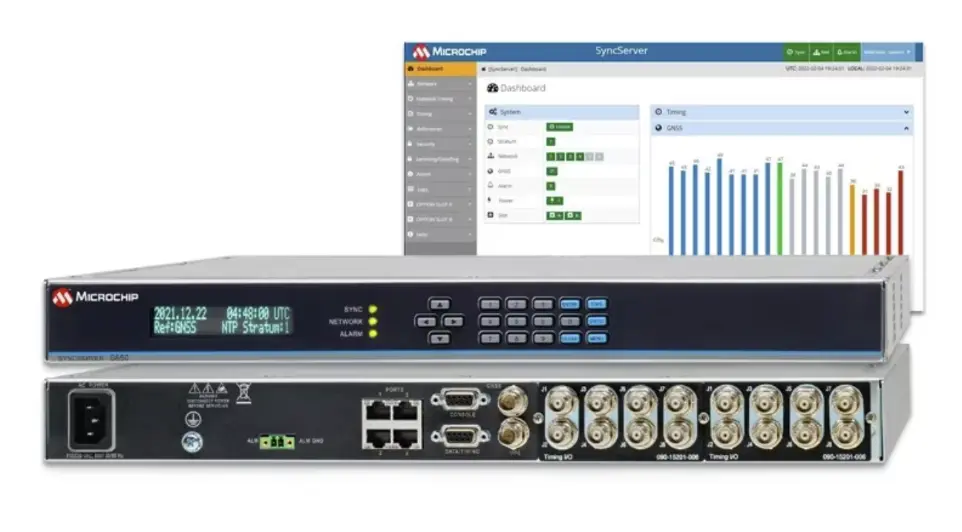
- TimeProvider 4100 supports telecom synchronization. SyncServer S600/S650 serve network timing requirements, while SyncSystem 4380A supports precision time and frequency distribution. Verify each model’s interfaces, options and supported profiles.
- Sustain and observe
- A 5071B cesium frequency standard can support a stable local reference within the appropriate timing architecture. TimePictra brings synchronization management and monitoring into operations.
Microchip’s Jammertest report describes how BlueSky measurements and TimeProvider alarms responded to controlled interference. Test results should inform a design, not substitute for validating the installed system.
Make the failure test part of the design.
Start with the services that have the least tolerance for timing error. Document their reference sources, distribution paths and alarm owners, then exercise the design in a controlled test environment.
Before the interruption
Record normal time error and source selection. Set an acceptance limit for each critical service.
While the reference is unavailable
Measure timing error at the endpoints. Confirm alarms, fallback selection and service behaviour.
When the reference returns
Verify that the source is trusted, the transition is stable and the clock correction stays acceptable.
ECIN helps Canadian operators turn that evidence into a practical timing architecture, from assessment and product selection to integration, interoperability testing and deployment support.
PNT resilience, answered
How is PNT different from GPS?
Positioning, navigation and timing describe the services an operation needs. GPS is one satellite system that supplies them. A fixed network may depend mainly on its timing output. Resilience starts with identifying those dependencies and the accuracy each application requires.
What is the difference between jamming and spoofing?
Jamming interferes with reception and can make satellite signals unavailable. Spoofing introduces misleading signals that may cause incorrect time or position. Detection depends on the equipment and conditions, so a healthy receiver status alone does not prove that the reference is trustworthy.
Does another GNSS receiver provide an independent backup?
Another receiver protects against some equipment failures, but nearby receivers may experience the same interference. Another constellation can help with certain faults without removing that shared exposure. An independent backup needs a reference and delivery path whose vulnerabilities differ from the primary source.
Can PTP or SyncE replace a GNSS reference?
PTP can deliver time from a remote reference, provided the network and endpoints support the required accuracy. SyncE distributes frequency, not time of day. Neither automatically creates an independent source: trace the upstream reference and confirm that it remains usable during the same GNSS disruption.
How long can a system operate in holdover?
There is no universal duration. Useful holdover depends on oscillator quality, temperature, aging, prior synchronization and the application’s error tolerance. Specify the permitted time error and expected outage, then validate the actual hardware and configuration against those requirements.
What should an outage and recovery test measure?
Measure alarms, reference switching, endpoint time error and the effect on dependent services while GNSS is unavailable. During recovery, check how the system validates and reacquires the reference, including whether clock corrections introduce time steps or other disruption.
Trust Every Second.
Contact E.C.I. NETWORKS INC. to discuss GNSS resilience, PTP/SyncE synchronization, holdover requirements and secure timing architecture for your critical infrastructure.
Contact Our Team